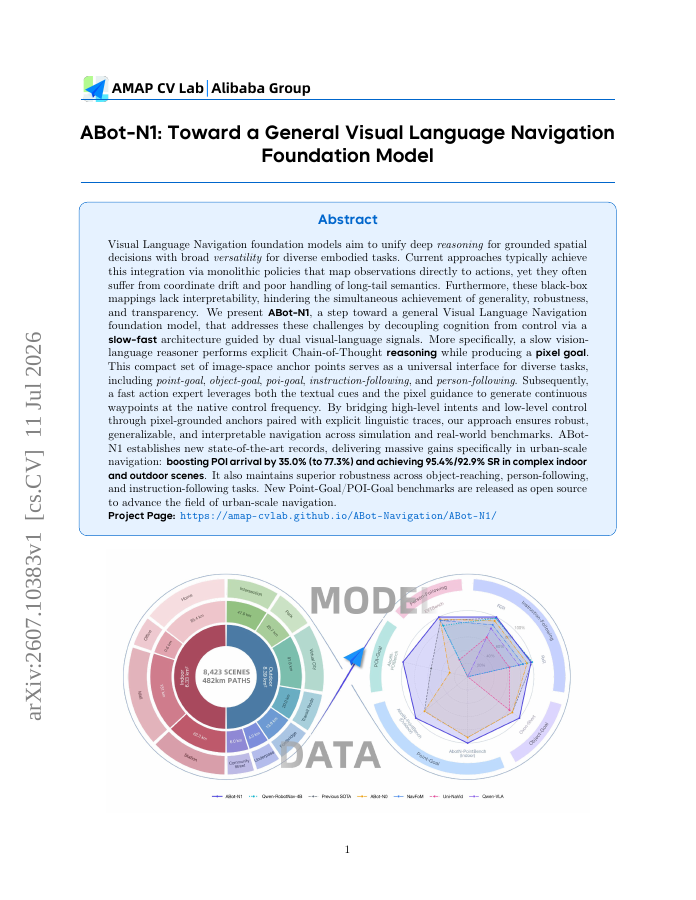
Visual Language Navigation foundation models aim to unify deep reasoning for grounded spatial decisions with broad versatility for diverse embodied tasks. Current approaches typically achieve this integration via monolithic policies that map observations directly to actions, yet they often suffer from coordinate drift and poor handling of long-tail semantics. Furthermore, these black-box mappings lack interpretability, hindering the simultaneous achievement of generality, robustness, and transparency. We present ABot-N1, a step toward a general Visual Language Navigation foundation model, that addresses these challenges by decoupling cognition from control via a slow-fast architecture guided by dual visual-language signals. More specifically, a slow vision-language reasoner performs explicit Chain-of-Thought reasoning while producing a pixel goal. This compact set of image-space anchor points serves as a universal interface for diverse tasks, including point-goal, object-goal, poi-goal, instruction-following, and person-following. Subsequently, a fast action expert leverages both the textual cues and the pixel guidance to generate continuous waypoints at the native control frequency. By bridging high-level intents and low-level control through pixel-grounded anchors paired with explicit linguistic traces, our approach ensures robust, generalizable, and interpretable navigation across simulation and real-world benchmarks. ABot-N1 establishes new state-of-the-art records, delivering massive gains specifically in urban-scale navigation: boosting POI arrival by 35.0% (to 77.3%) and achieving 95.4%/92.9% SR in complex indoor and outdoor scenes. It also maintains superior robustness across object-reaching, person-following, and instruction-following tasks. New Point-Goal/POI-Goal benchmarks are released as open source to advance the field of urban-scale navigation.
ABot-N1: Toward a General Visual Language Navigation Foundation Model
Visual Language Navigation foundation models aim to unify deep reasoning for grounded spatial decisions with broad versatility for diverse embodied tasks. Current approaches typically achieve this integration via monolithic policies that map observations directly to actions, yet…
- Preview
- Year
- 2026
- Hosting
- Abstract onlyARXIV-DEFAULT
Cite
Notes
Only stored in your browser.
Attribution
- Abstract & full text
- arxiv.org/abs/2607.10383ARXIV-DEFAULT
- TL;DR
- Semantic Scholar