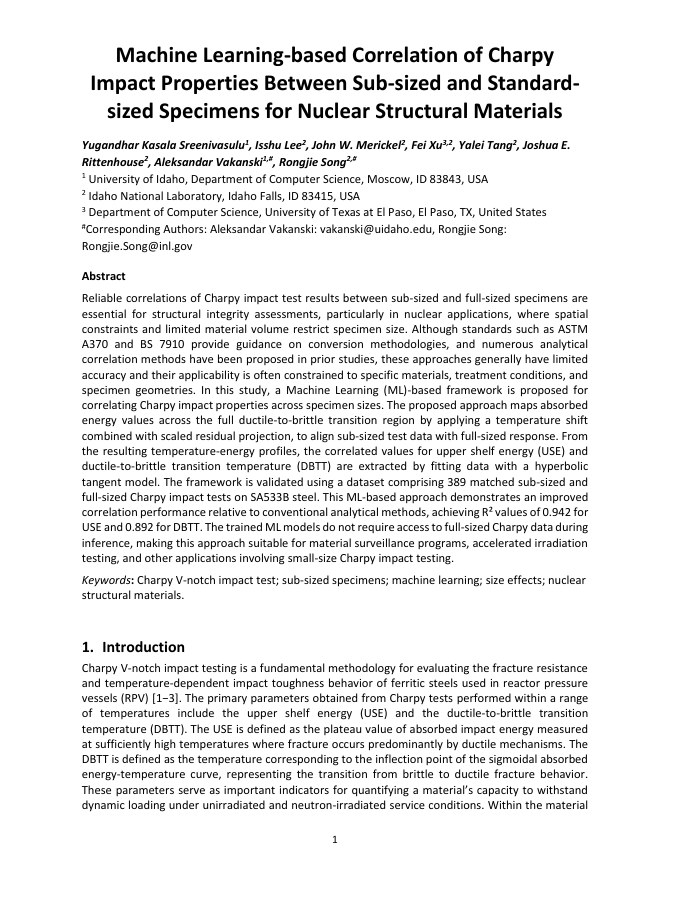
Reliable correlations of Charpy impact test results between sub-sized and full-sized specimens are essential for structural integrity assessments, particularly in nuclear applications, where spatial constraints and limited material volume restrict specimen size. Although standards such as ASTM A370 and BS 7910 provide guidance on conversion methodologies, and numerous analytical correlation methods have been proposed in prior studies, these approaches generally have limited accuracy and their applicability is often constrained to specific materials, treatment conditions, and specimen geometries. In this study, a Machine Learning (ML)-based framework is proposed for correlating Charpy impact properties across specimen sizes. The proposed approach maps absorbed energy values across the full ductile-to-brittle transition region by applying a temperature shift combined with scaled residual projection, to align sub-sized test data with full-sized response. From the resulting temperature-energy profiles, the correlated values for upper shelf energy (USE) and ductile-to-brittle transition temperature (DBTT) are extracted by fitting data with a hyperbolic tangent model. The framework is validated using a dataset comprising 389 matched sub-sized and full-sized Charpy impact tests on SA533B steel. This ML-based approach demonstrates an improved correlation performance relative to conventional analytical methods, achieving R2 values of 0.942 for USE and 0.892 for DBTT. The trained ML models do not require access to full-sized Charpy data during inference, making this approach suitable for material surveillance programs, accelerated irradiation testing, and other applications involving small-size Charpy impact testing.
Machine Learning-based Correlation of Charpy Impact Properties Between Sub-sized and Standard-sized Specimens for Nuclear Structural Materials
Reliable correlations of Charpy impact test results between sub-sized and full-sized specimens are essential for structural integrity assessments, particularly in nuclear applications, where spatial constraints and limited material volume restrict specimen size.
- Preview
- Year
- 2026
- Hosting
- Full text hostedCC-BY-4.0
Cite
Notes
Only stored in your browser.
Attribution
- Abstract & full text
- arxiv.org/abs/2607.10412CC-BY-4.0
- TL;DR
- Semantic Scholar