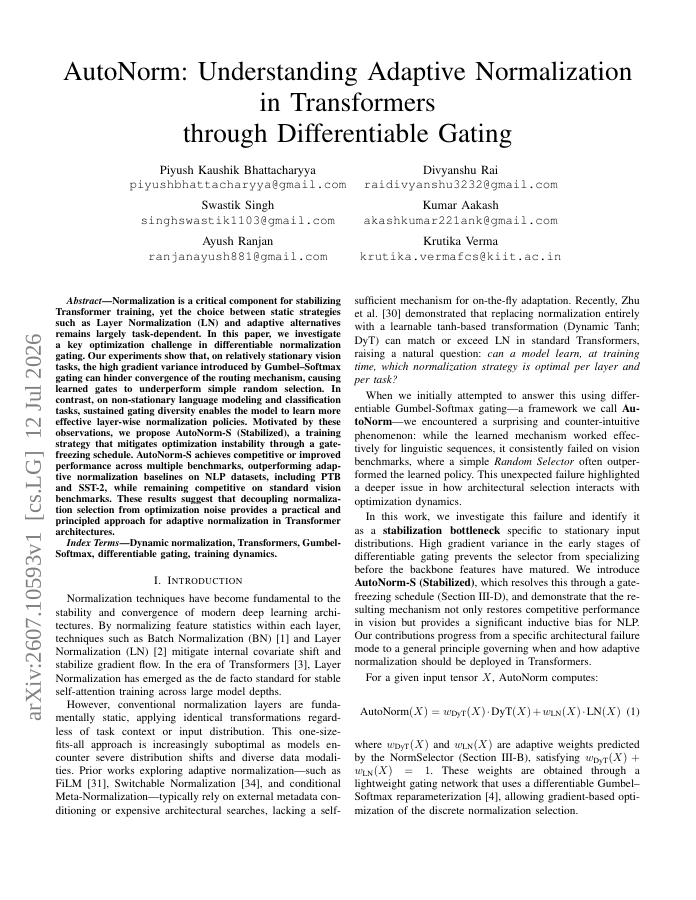
Normalization is a critical component for stabilizing Transformer training, yet the choice between static strategies such as Layer Normalization (LN) and adaptive alternatives remains largely task-dependent. In this paper, we investigate a key optimization challenge in differentiable normalization gating. Our experiments show that, on relatively stationary vision tasks, the high gradient variance introduced by Gumbel-Softmax gating can hinder convergence of the routing mechanism, causing learned gates to underperform simple random selection. In contrast, on non-stationary language modeling and classification tasks, sustained gating diversity enables the model to learn more effective layer-wise normalization policies. Motivated by these observations, we propose AutoNorm-S (Stabilized), a training strategy that mitigates optimization instability through a gate-freezing schedule. AutoNorm-S achieves competitive or improved performance across multiple benchmarks, outperforming adaptive normalization baselines on NLP datasets, including PTB and SST-2, while remaining competitive on standard vision benchmarks. These results suggest that decoupling normalization selection from optimization noise provides a practical and principled approach for adaptive normalization in Transformer architectures.
AutoNorm: Understanding Adaptive Normalization in Transformers through Differentiable Gating
Normalization is a critical component for stabilizing Transformer training, yet the choice between static strategies such as Layer Normalization (LN) and adaptive alternatives remains largely task-dependent.
- Preview
- Year
- 2026
- Hosting
- Full text hostedCC-BY-4.0
Cite
Notes
Only stored in your browser.
Attribution
- Abstract & full text
- arxiv.org/abs/2607.10593CC-BY-4.0
- TL;DR
- Semantic Scholar