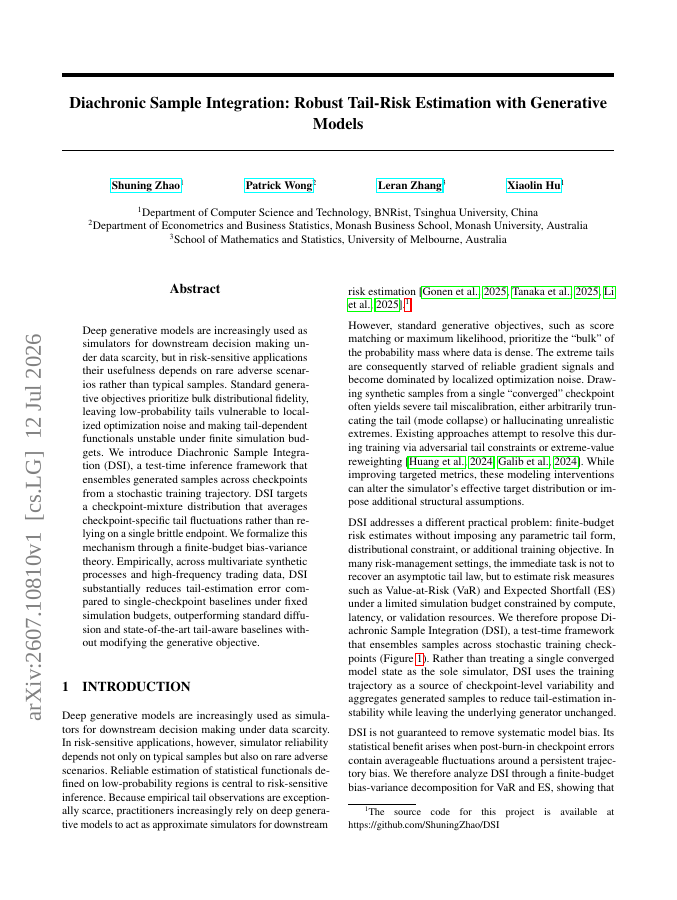
Deep generative models are increasingly used as simulators for downstream decision-making under data scarcity, but in risk-sensitive applications their usefulness depends on rare adverse scenarios rather than typical samples. Standard generative objectives prioritize bulk distributional fidelity, leaving low-probability tails vulnerable to localized optimization noise and making tail-dependent functionals unstable under finite simulation budgets. We introduce Diachronic Sample Integration (DSI), a test-time inference framework that ensembles generated samples across checkpoints from a stochastic training trajectory. DSI targets a checkpoint-mixture distribution that averages checkpoint-specific tail fluctuations rather than relying on a single brittle endpoint. We formalize this mechanism through a finite-budget bias-variance theory. Empirically, across multivariate synthetic processes and high-frequency trading data, DSI substantially reduces tail-estimation error compared to single-checkpoint baselines under fixed simulation budgets, outperforming standard diffusion and state-of-the-art tail-aware baselines without modifying the generative objective.
Diachronic Sample Integration: Robust Tail-Risk Estimation with Generative Models
Deep generative models are increasingly used as simulators for downstream decision-making under data scarcity, but in risk-sensitive applications their usefulness depends on rare adverse scenarios rather than typical samples.
- Preview
- Year
- 2026
- Hosting
- Abstract onlyARXIV-DEFAULT
Cite
Notes
Only stored in your browser.
Attribution
- Abstract & full text
- arxiv.org/abs/2607.10810ARXIV-DEFAULT
- TL;DR
- Semantic Scholar