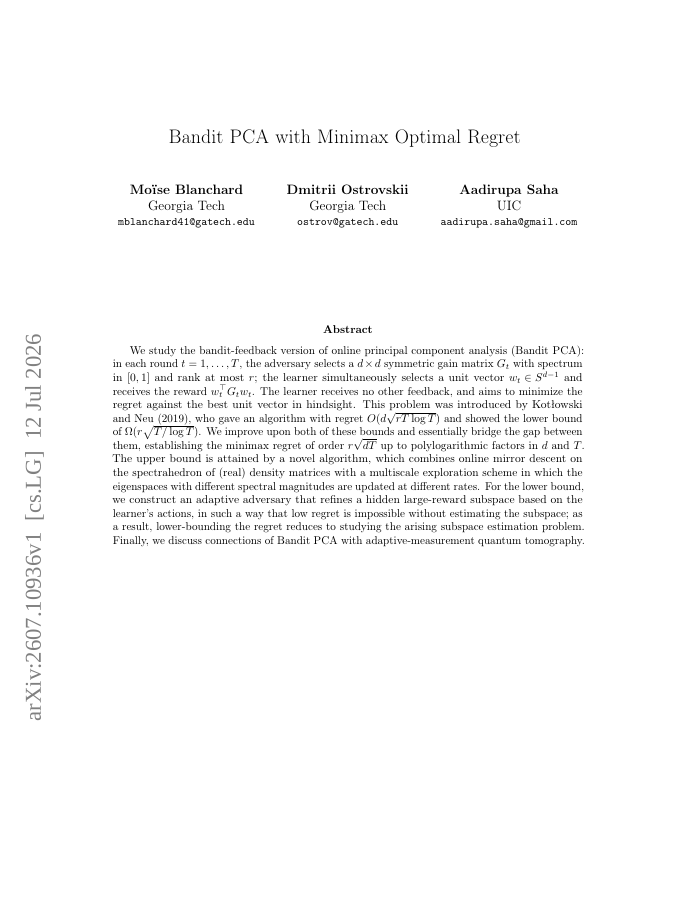
We study the bandit-feedback version of online principal component analysis (Bandit PCA): in each round t = 1,\dots,T, the adversary selects a d \times d symmetric gain matrix G_t with spectrum in [0,1] and rank at most r; the learner simultaneously selects a unit vector w_t \in S^{d-1} and receives the reward w_t^\top G_t w_t. The learner receives no other feedback, and aims to minimize the regret against the best unit vector in hindsight. This problem was introduced by Kotlowski and Neu (2019), who gave an algorithm with regret O(d\sqrt{rT \log T}) and showed the lower bound of Ω(r\sqrt{T/\log T}). We improve upon both of these bounds and essentially bridge the gap between them, establishing the minimax regret of order r\sqrt{dT} up to polylogarithmic factors in d and T. The upper bound is attained by a novel algorithm, which combines online mirror descent on the spectrahedron of (real) density matrices with a multiscale exploration scheme in which the eigenspaces with different spectral magnitudes are updated at different rates. For the lower bound, we construct an adaptive adversary that refines a hidden large-reward subspace based on the learner's actions, in such a way that low regret is impossible without estimating the subspace; as a result, lower-bounding the regret reduces to studying the arising subspace estimation problem. Finally, we discuss connections of Bandit PCA with adaptive-measurement quantum tomography.
Bandit PCA with Minimax Optimal Regret
We study the bandit-feedback version of online principal component analysis (Bandit PCA): in each round $t = 1,\dots,T$, the adversary selects a $d \times d$ symmetric gain matrix $G_t$ with spectrum in $[0,1]$ and rank at most $r$; the learner simultaneously selects a unit…
- Preview
- Year
- 2026
- Hosting
- Abstract onlyARXIV-DEFAULT
Cite
Notes
Only stored in your browser.
Attribution
- Abstract & full text
- arxiv.org/abs/2607.10936ARXIV-DEFAULT
- TL;DR
- Semantic Scholar