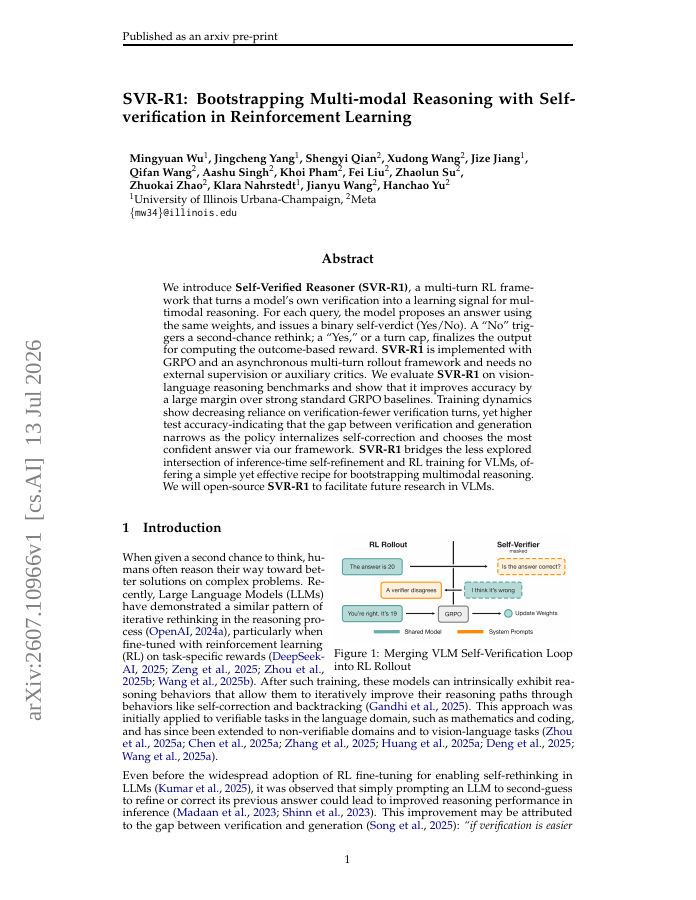
We introduce Self-Verified Reasoner (SVR-R1), a multi-turn RL framework that turns a model's own verification into a learning signal for multimodal reasoning. For each query, the model proposes an answer using the same weights, and issues a binary self-verdict (Yes/No). A 'No' triggers a second-chance rethink; a 'Yes,' or a turn cap, finalizes the output for computing the outcome-based reward. SVR-R1 is implemented with GRPO and an asynchronous multi-turn rollout framework and needs no external supervision or auxiliary critics. We evaluate SVR-R1 on vision-language reasoning benchmarks and show that it improves accuracy by a large margin over strong standard GRPO baselines. Training dynamics show decreasing reliance on verification-fewer verification turns, yet higher test accuracy-indicating that the gap between verification and generation narrows as the policy internalizes self-correction and chooses the most confident answer via our framework. SVR-R1 bridges the less explored intersection of inference-time self-refinement and RL training for VLMs, offering a simple yet effective recipe for bootstrapping multimodal reasoning. We will open-source SVR-R1 to facilitate future research in VLMs.
SVR-R1: Bootstrapping Multi-modal Reasoning with Self-verification in Reinforcement Learning
We introduce Self-Verified Reasoner (SVR-R1), a multi-turn RL framework that turns a model's own verification into a learning signal for multimodal reasoning. For each query, the model proposes an answer using the same weights, and issues a binary self-verdict (Yes/No).
- Preview
- Year
- 2026
- Hosting
- Excerpt onlyCC-BY-NC-SA-4.0
Cite
Notes
Only stored in your browser.
Attribution
- Abstract & full text
- arxiv.org/abs/2607.10966CC-BY-NC-SA-4.0
- TL;DR
- Semantic Scholar