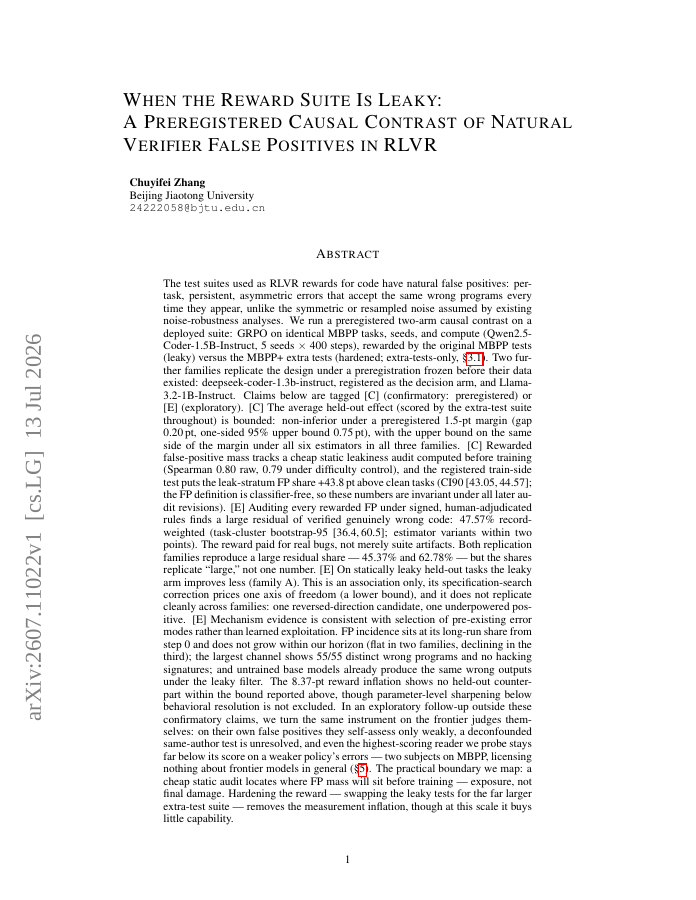
The test suites used as RLVR rewards for code have natural false positives: per-task, persistent, asymmetric errors that accept the same wrong programs every time they appear, unlike the symmetric or resampled noise assumed by existing noise-robustness analyses. We run a preregistered two-arm causal contrast on a deployed suite: GRPO on identical MBPP tasks, seeds, and compute, rewarded by the original MBPP tests (leaky) versus the MBPP+ extra tests (hardened). Two further families replicate the design under a preregistration frozen before their data existed. [C] The average held-out effect is bounded: non-inferior under a preregistered 1.5-pt margin (gap 0.20 pt, one-sided 95% upper bound 0.75 pt). [C] Rewarded false-positive mass tracks a cheap static leakiness audit computed before training (Spearman 0.80), and the registered train-side test puts the leak-stratum FP share +43.8 pt above clean tasks. [E] Auditing every rewarded FP under signed, human-adjudicated rules finds a large residual of verified genuinely wrong code: 47.57% record-weighted; both replication families reproduce a large share. The reward paid for real bugs, not merely suite artifacts. [E] Mechanism evidence is consistent with selection of pre-existing error modes rather than learned exploitation: FP incidence does not grow within our horizon, and untrained base models already produce the same wrong outputs under the leaky filter. We then turn the same instrument on the frontier judges themselves: on their own false positives they self-assess only weakly, a same-author test is unresolved, and even the highest-scoring reader we probe stays far below its score on a weaker policy's errors -- two subjects on MBPP, licensing nothing about frontier models in general. A cheap static audit locates exposure before training; hardening the reward removes the measurement inflation, though here it buys little capability.
When the Reward Suite Is Leaky: A Preregistered Causal Contrast of Natural Verifier False Positives in RLVR
The test suites used as RLVR rewards for code have natural false positives: per-task, persistent, asymmetric errors that accept the same wrong programs every time they appear, unlike the symmetric or resampled noise assumed by existing noise-robustness analyses.
- Preview
- Year
- 2026
- Hosting
- Full text hostedCC-BY-4.0
Cite
Notes
Only stored in your browser.
Attribution
- Abstract & full text
- arxiv.org/abs/2607.11022CC-BY-4.0
- TL;DR
- Semantic Scholar