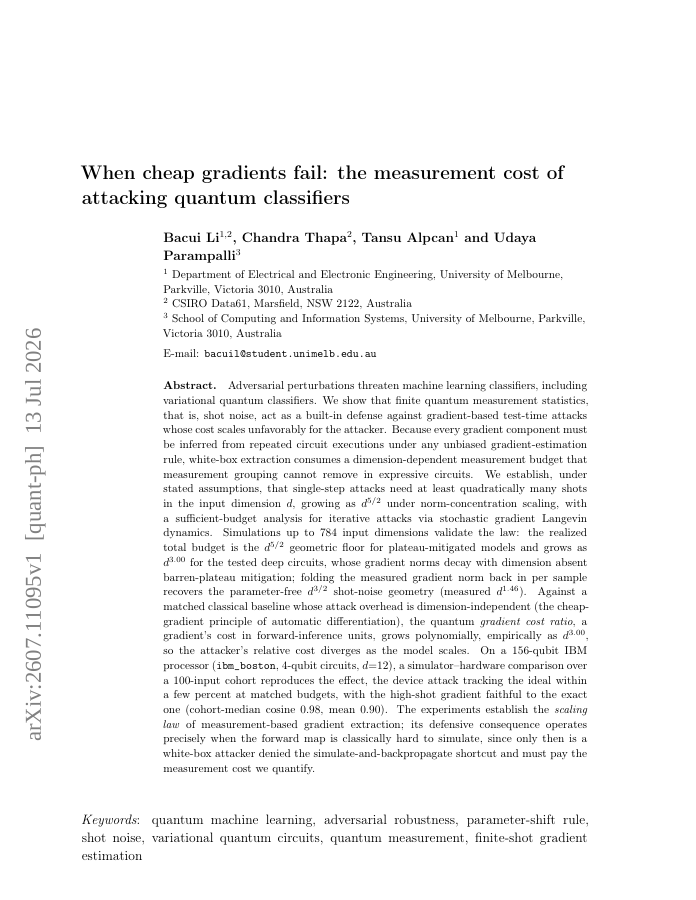
Adversarial perturbations threaten machine learning classifiers, including variational quantum classifiers. We show that finite quantum measurement statistics (shot noise) act as a built-in defense against gradient-based test-time attacks whose cost scales unfavorably for the attacker. Because every gradient component must be inferred from repeated circuit executions under any unbiased gradient-estimation rule, white-box extraction consumes a dimension-dependent measurement budget that measurement grouping cannot remove in expressive circuits. Under stated assumptions, single-step attacks need at least quadratically many shots in the input dimension d, growing as d^{5/2} under norm-concentration scaling, with a sufficient-budget analysis for iterative attacks via stochastic gradient Langevin dynamics. Simulations up to 784 input dimensions validate the law: the realized total budget is the d^{5/2} geometric floor for plateau-mitigated models and grows as d^{3.00} for the tested deep circuits, whose gradient norms decay with dimension absent barren-plateau mitigation; folding the measured gradient norm back in recovers the parameter-free d^{3/2} shot-noise geometry. Against a matched classical baseline whose attack overhead is dimension-independent (the cheap-gradient principle of automatic differentiation), the quantum gradient cost ratio grows empirically as d^{3.00}, so the attacker's relative cost diverges as the model scales. Experiments on a 156-qubit IBM processor (ibm_boston, 4-qubit circuits, d=12) reproduce the effect: at matched budgets the device attack tracks the ideal within a few percent, with the high-shot gradient faithful to the exact one. The defense operates precisely when the forward map is classically hard to simulate: only then is a white-box attacker denied the simulate-and-backpropagate shortcut and must pay the measurement cost we quantify.
When cheap gradients fail: the measurement cost of attacking quantum classifiers
Adversarial perturbations threaten machine learning classifiers, including variational quantum classifiers. We show that finite quantum measurement statistics (shot noise) act as a built-in defense against gradient-based test-time attacks whose cost scales unfavorably for the…
- Preview
- Year
- 2026
- Hosting
- Full text hostedCC-BY-4.0
Cite
Notes
Only stored in your browser.
Attribution
- Abstract & full text
- arxiv.org/abs/2607.11095CC-BY-4.0
- TL;DR
- Semantic Scholar