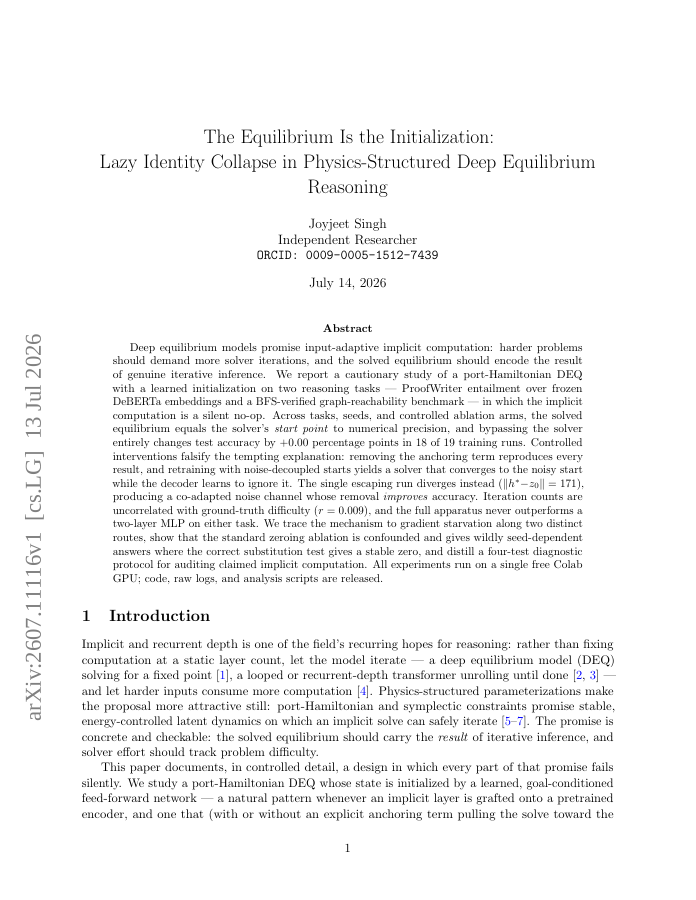
Deep equilibrium models promise input-adaptive implicit computation: harder problems should demand more solver iterations, and the solved equilibrium should encode the result of genuine iterative inference. We report a cautionary study of a port-Hamiltonian DEQ with a learned initialization on two reasoning tasks -- ProofWriter entailment over frozen DeBERTa embeddings and a BFS-verified graph-reachability benchmark -- in which the implicit computation is a silent no-op. Across tasks, seeds, and controlled ablation arms, the solved equilibrium equals the solver's start point to numerical precision, and bypassing the solver entirely changes test accuracy by +0.00 percentage points in 18 of 19 training runs. Controlled interventions falsify the tempting explanation: removing the anchoring term reproduces every result, and retraining with noise-decoupled starts yields a solver that converges to the noisy start while the decoder learns to ignore it. The single escaping run diverges instead (|h^{*}-z_0|=171), producing a co-adapted noise channel whose removal improves accuracy. Iteration counts are uncorrelated with ground-truth difficulty (r=0.009), and the full apparatus never outperforms a two-layer MLP on either task. We trace the mechanism to gradient starvation along two distinct routes, show that the standard zeroing ablation is confounded and gives wildly seed-dependent answers where the correct substitution test gives a stable zero, and distill a four-test diagnostic protocol for auditing claimed implicit computation. All experiments run on a single free Colab GPU; code, raw logs, and analysis scripts are released.
The Equilibrium Is the Initialization: Lazy Identity Collapse in Physics-Structured Deep Equilibrium Reasoning
Deep equilibrium models promise input-adaptive implicit computation: harder problems should demand more solver iterations, and the solved equilibrium should encode the result of genuine iterative inference.
- Preview
- Year
- 2026
- Hosting
- Full text hostedCC-BY-4.0
Cite
Notes
Only stored in your browser.
Attribution
- Abstract & full text
- arxiv.org/abs/2607.11116CC-BY-4.0
- TL;DR
- Semantic Scholar