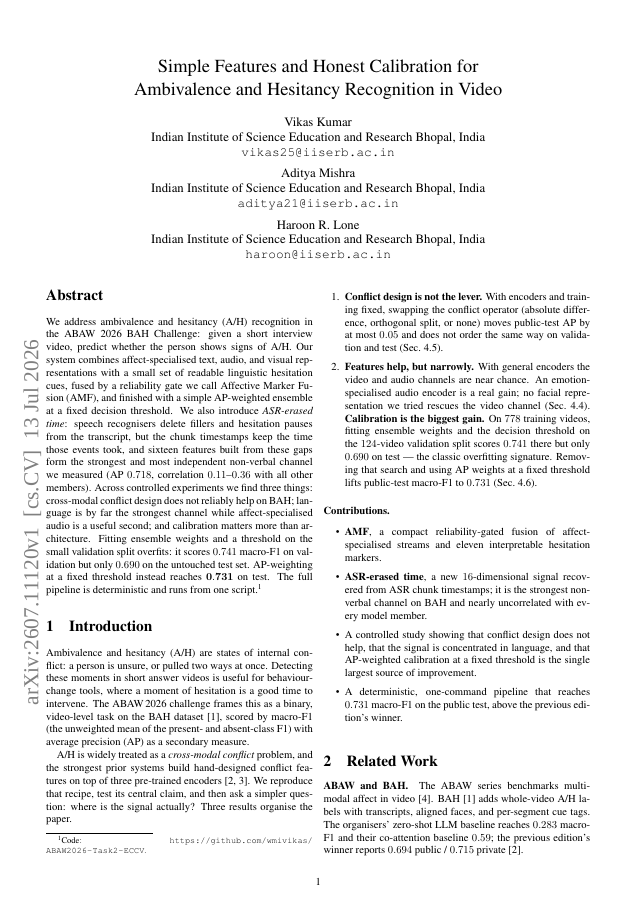
We address ambivalence and hesitancy (A/H) recognition in the ABAW 2026 BAH Challenge: given a short interview video, predict whether the person shows signs of A/H. Our system combines affect-specialised text, audio, and visual representations with a small set of readable linguistic hesitation cues, fused by a reliability gate we call Affective Marker Fusion (AMF), and finished with a simple AP-weighted ensemble at a fixed decision threshold. We also introduce ASR-erased time: speech recognisers delete fillers and hesitation pauses from the transcript, but the chunk timestamps keep the time those events took, and sixteen features built from these gaps form the strongest and most independent non-verbal channel we measured (AP 0.718, correlation 0.11--0.36 with all other members). Across controlled experiments we find three things: cross-modal conflict design does not reliably help on BAH; language is by far the strongest channel while affect-specialised audio is a useful second; and calibration matters more than architecture. Fitting ensemble weights and a threshold on the small validation split overfits: it scores 0.741 macro-F1 on validation but only 0.690 on the untouched test set. AP-weighting at a fixed threshold instead reaches 0.731 on test.
Simple Features and Honest Calibration for Ambivalence and Hesitancy Recognition in Video
We address ambivalence and hesitancy (A/H) recognition in the ABAW 2026 BAH Challenge: given a short interview video, predict whether the person shows signs of A/H. Our system combines affect-specialised text, audio, and visual representations with a small set of readable…
- Preview
- Year
- 2026
- Hosting
- Full text hostedCC-BY-4.0
Cite
Notes
Only stored in your browser.
Attribution
- Abstract & full text
- arxiv.org/abs/2607.11120CC-BY-4.0
- TL;DR
- Semantic Scholar