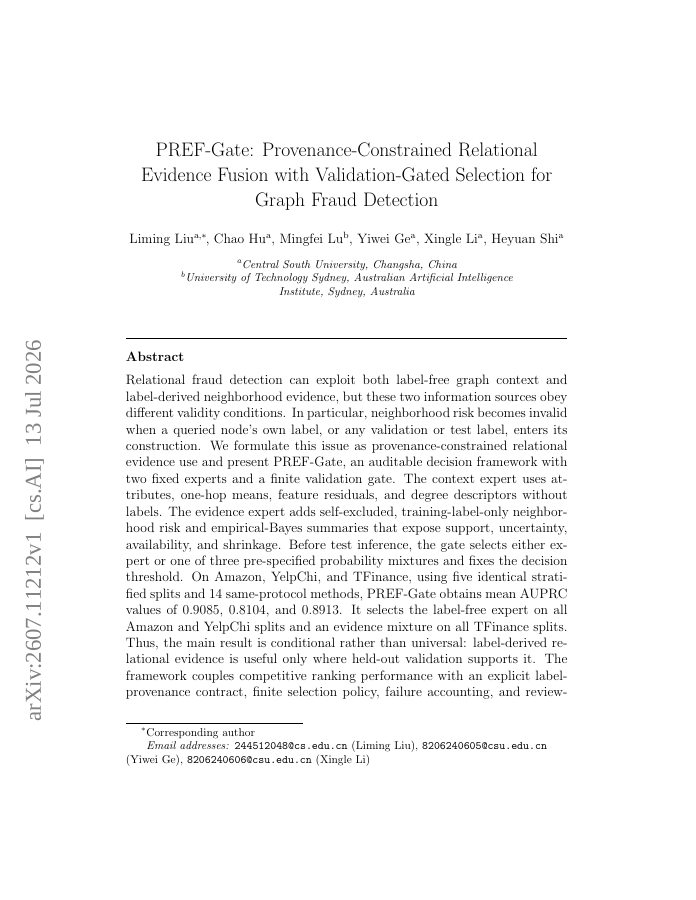
Relational fraud detection can exploit both label-free graph context and label-derived neighborhood evidence, but these two information sources obey different validity conditions. In particular, neighborhood risk becomes invalid when a queried node's own label, or any validation or test label, enters its construction. We formulate this issue as provenance-constrained relational evidence use and present PREF-Gate, an auditable decision framework with two fixed experts and a finite validation gate. The context expert uses attributes, one-hop means, feature residuals, and degree descriptors without labels. The evidence expert adds self-excluded, training-label-only neighborhood risk and empirical-Bayes summaries that expose support, uncertainty, availability, and shrinkage. Before test inference, the gate selects either expert or one of three pre-specified probability mixtures and fixes the decision threshold. On Amazon, YelpChi, and TFinance, using five identical stratified splits and 14 same-protocol methods, PREF-Gate obtains mean AUPRC values of 0.9085, 0.8104, and 0.8913. It selects the label-free expert on all Amazon and YelpChi splits and an evidence mixture on all TFinance splits. Thus, the main result is conditional rather than universal: label-derived relational evidence is useful only where held-out validation supports it. The framework couples competitive ranking performance with an explicit label-provenance contract, finite selection policy, failure accounting, and review-budget evaluation, providing an auditable knowledge-based decision pipeline for graph fraud detection.
PREF-Gate: Provenance-Constrained Relational Evidence Fusion with Validation-Gated Selection for Graph Fraud Detection
Relational fraud detection can exploit both label-free graph context and label-derived neighborhood evidence, but these two information sources obey different validity conditions.
- Preview
- Year
- 2026
- Hosting
- Full text hostedCC-BY-4.0
Cite
Notes
Only stored in your browser.
Attribution
- Abstract & full text
- arxiv.org/abs/2607.11212CC-BY-4.0
- TL;DR
- Semantic Scholar