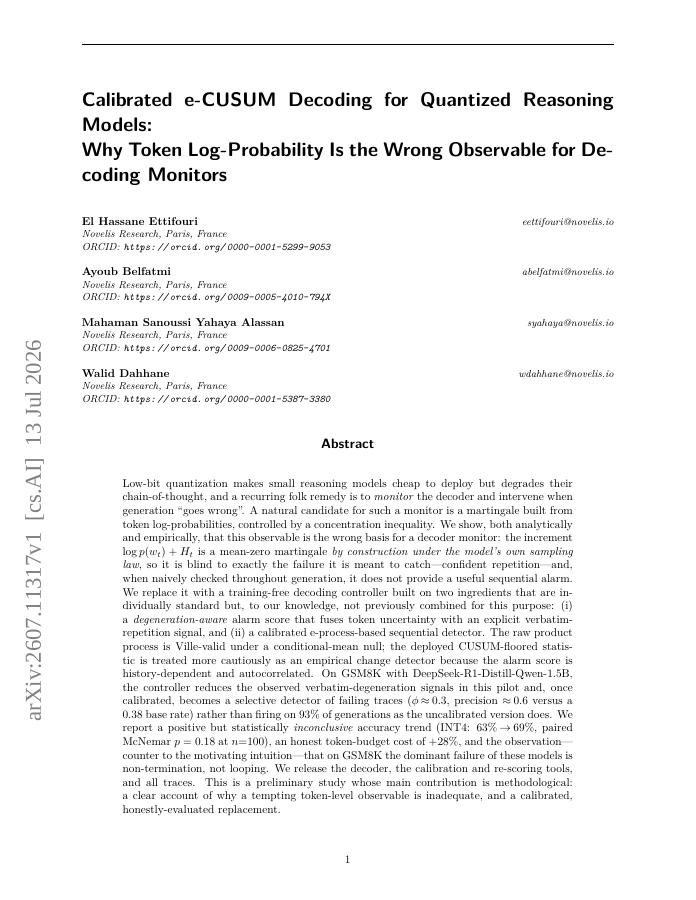
Low-bit quantization makes small reasoning models inexpensive to deploy but can degrade their chains of thought. This motivates decoder-side monitors that intervene when generation becomes unreliable. We show that a natural candidate, the centered token log-probability increment \log p(w_t)+H_t, is the wrong observable for this purpose. Under the model's own sampling law it is a mean-zero martingale by construction, so it measures sampling self-consistency rather than trajectory health and is nearly silent during confident repetition, where both \log p(w_t) and entropy are close to zero. We introduce a training-free decoding controller that combines (i) a degeneration-aware alarm score fusing token uncertainty with explicit verbatim repetition and (ii) a calibrated e-process-inspired sequential detector. The raw product process is Ville-valid under a conditional-mean null, while the deployed CUSUM-floored statistic is treated as an empirical change detector because the score is history-dependent and autocorrelated. On GSM8K with DeepSeek-R1-Distill-Qwen-1.5B in FP16 and INT4, calibration turns a monitor that fires on 93--95% of generations into a selective detector of failing traces (ϕ\approx 0.3, precision \approx 0.6 against a 0.38 base rate). In this pilot, the controller reduces measured verbatim-degeneration signals and yields a positive but statistically inconclusive INT4 accuracy change from 63% to 69% (paired McNemar p=0.18, n=100), at a 28% token-budget cost. We also find that non-termination, rather than looping, is the dominant failure mode on GSM8K. The main contribution is methodological: an explanation of why centered token log-probability is inadequate for decoder monitoring and a calibrated, cautiously evaluated replacement.
Calibrated e-CUSUM Decoding for Quantized Reasoning Models: Why Token Log-Probability Is the Wrong Observable for Decoding Monitors
Low-bit quantization makes small reasoning models inexpensive to deploy but can degrade their chains of thought. This motivates decoder-side monitors that intervene when generation becomes unreliable.
- Preview
- Year
- 2026
- Hosting
- Full text hostedCC-BY-4.0
Cite
Notes
Only stored in your browser.
Attribution
- Abstract & full text
- arxiv.org/abs/2607.11317CC-BY-4.0
- TL;DR
- Semantic Scholar