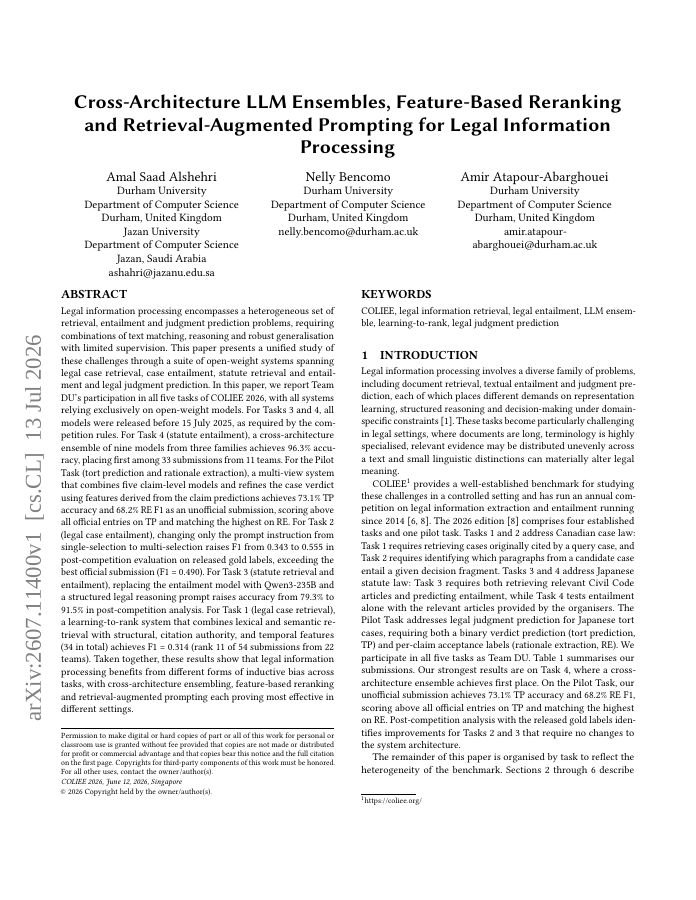
Legal information processing spans retrieval, entailment and judgment prediction problems, requiring text matching, reasoning and robust generalisation with limited supervision. We report Team DU's participation in all five tasks of COLIEE 2026, using open-weight systems for legal case retrieval, case entailment, statute retrieval and entailment, and legal judgment prediction. For Tasks 3 and 4, all models predate the 15 July 2025 cutoff required by the rules. For Task 4 (statute entailment), a cross-architecture ensemble of nine models from three families achieves 96.3% accuracy, placing first among 33 submissions from 11 teams. For the Pilot Task (tort prediction and rationale extraction), a multi-view system combining five claim-level models and refining the verdict using features derived from the claim predictions achieves 73.1% TP accuracy and 68.2% RE F1 as an unofficial submission, scoring above all official entries on TP and matching the highest on RE. For Task 2 (legal case entailment), changing only the prompt from single- to multi-selection raises F1 from 0.343 to 0.555 in post-competition evaluation on released gold labels, exceeding the best official submission (F1 = 0.490). For Task 3 (statute retrieval and entailment), replacing the entailment model with Qwen3-235B and a structured legal reasoning prompt raises accuracy from 79.3% to 91.5% in post-competition analysis. For Task 1 (legal case retrieval), a learning-to-rank system combining lexical and semantic retrieval with structural, citation authority, and temporal features (34 in total) achieves F1 = 0.314 (rank 11 of 54 submissions from 22 teams). Overall, legal information processing benefits from different inductive biases across tasks, with cross-architecture ensembling, feature-based reranking and retrieval-augmented prompting each proving most effective in different settings.
Cross-Architecture LLM Ensembles, Feature-Based Reranking and Retrieval-Augmented Prompting for Legal Information Processing
Legal information processing spans retrieval, entailment and judgment prediction problems, requiring text matching, reasoning and robust generalisation with limited supervision.
- Preview
- Year
- 2026
- Hosting
- Abstract onlyARXIV-DEFAULT
Cite
Notes
Only stored in your browser.
Attribution
- Abstract & full text
- arxiv.org/abs/2607.11400ARXIV-DEFAULT
- TL;DR
- Semantic Scholar