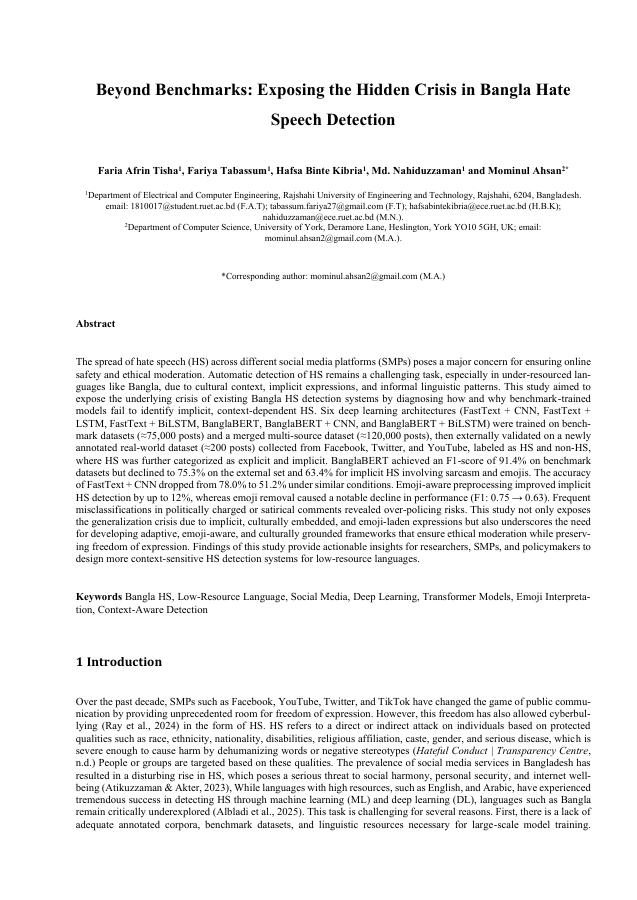
The spread of hate speech (HS) across different social media platforms (SMPs) poses a major concern for online safety and ethical moderation. Automatic detection of HS remains a challenging task, especially in under-resourced languages like Bangla, due to cultural context, implicit expressions, and informal linguistic patterns. This study aimed to expose the crisis of Bangla HS detection systems by diagnosing how and why benchmark-trained models fail to identify implicit, context-dependent HS. Six architectures (FastText + CNN, FastText + LSTM, FastText + BiLSTM, BanglaBERT, BanglaBERT + CNN, and BanglaBERT + BiLSTM) were trained on benchmark datasets (about 75,000 posts) and a merged multi-source dataset (about 120,000 posts), then externally validated on an annotated dataset (about 200 posts) collected from Facebook, Twitter, and YouTube, labeled as HS and non-HS, where HS was further categorized as explicit and implicit. BanglaBERT achieved an F1-score of 91.4% on benchmark datasets but declined to 75.3% on the external set and 63.4% for implicit HS involving sarcasm and emojis. The accuracy of FastText + CNN dropped from 78.0% to 51.2% under similar conditions. Emoji-aware preprocessing improved implicit HS detection by up to 12%, whereas emoji removal caused a notable decline in performance (F1: 0.75 to 0.63). Frequent misclassifications in politically charged or satirical comments revealed over-policing risks. This study not only exposes the generalization crisis due to implicit, culturally embedded, and emoji-laden expressions but also underscores the need for developing adaptive, emoji-aware, and culturally grounded frameworks that ensure ethical moderation while preserving freedom of expression. Findings of this study provide insights for researchers, SMPs, and policymakers to design more context-sensitive HS detection systems for low-resource languages.
Beyond Benchmarks: Exposing the Hidden Crisis in Bangla Hate Speech Detection
The spread of hate speech (HS) across different social media platforms (SMPs) poses a major concern for online safety and ethical moderation. Automatic detection of HS remains a challenging task, especially in under-resourced languages like Bangla, due to cultural context,…
- Preview
- Year
- 2026
- Hosting
- Abstract onlyARXIV-DEFAULT
Cite
Notes
Only stored in your browser.
Attribution
- Abstract & full text
- arxiv.org/abs/2607.11597ARXIV-DEFAULT
- TL;DR
- Semantic Scholar