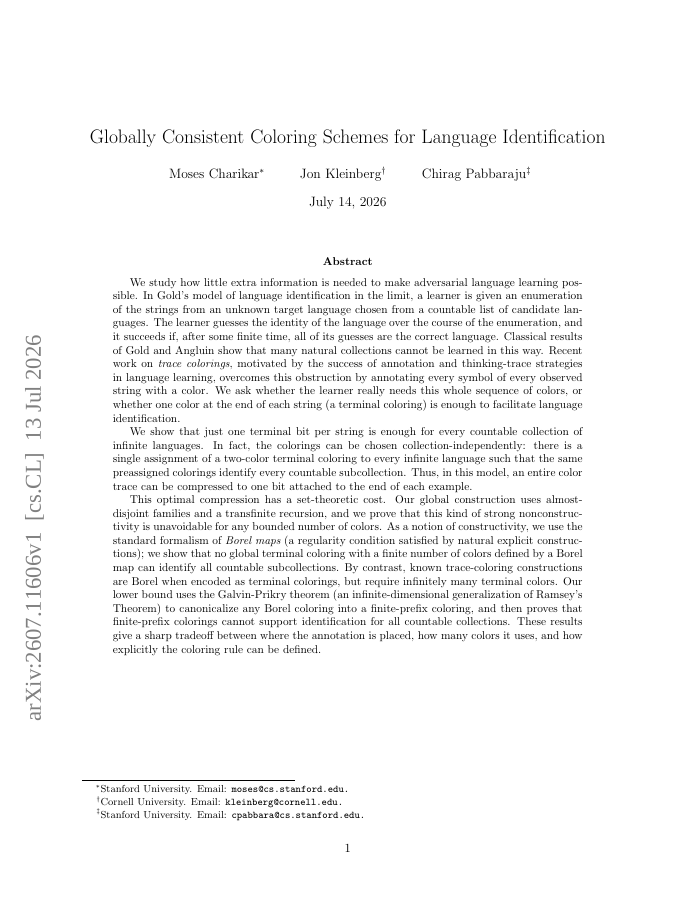
We study how little extra information is needed to make adversarial language learning possible. In Gold's model of language identification in the limit, a learner is given an enumeration of the strings from an unknown language chosen from a countable language collection. The learner guesses the identity of the language over the course of the enumeration, and it succeeds if, eventually, all of its guesses are the correct language. Classical results of Gold and Angluin show that many natural collections cannot be learned in this way. Recent work on trace colorings, motivated by the success of thinking-trace strategies in language learning, overcomes this obstruction by annotating every symbol of every string with a color. We ask whether the learner really needs this whole sequence of colors, or whether one color at the end of each string (a terminal coloring) is enough for language identification. We show that just one terminal bit per string is enough for every countable collection of infinite languages. In fact, the colorings can be chosen collection-independently: there is a single assignment of a two-color terminal coloring to every infinite language such that the same preassigned colorings identify every countable subcollection. Thus, in this model, an entire color trace can be compressed to one bit attached to the end of each example. Our global construction uses transfinite recursion, and we prove that this kind of nonconstructivity is unavoidable for any bounded number of colors. As a notion of constructivity, we use the formalism of Borel maps (a regularity condition satisfied by natural explicit constructions); we show that no global terminal coloring with a finite number of colors defined by a Borel map can identify all countable subcollections. By contrast, known trace-coloring constructions are Borel when encoded as terminal colorings, but require infinitely many colors.
Globally Consistent Coloring Schemes for Language Identification
We study how little extra information is needed to make adversarial language learning possible. In Gold's model of language identification in the limit, a learner is given an enumeration of the strings from an unknown language chosen from a countable language collection.
- Preview
- Year
- 2026
- Hosting
- Full text hostedCC-BY-4.0
Cite
Notes
Only stored in your browser.
Attribution
- Abstract & full text
- arxiv.org/abs/2607.11606CC-BY-4.0
- TL;DR
- Semantic Scholar