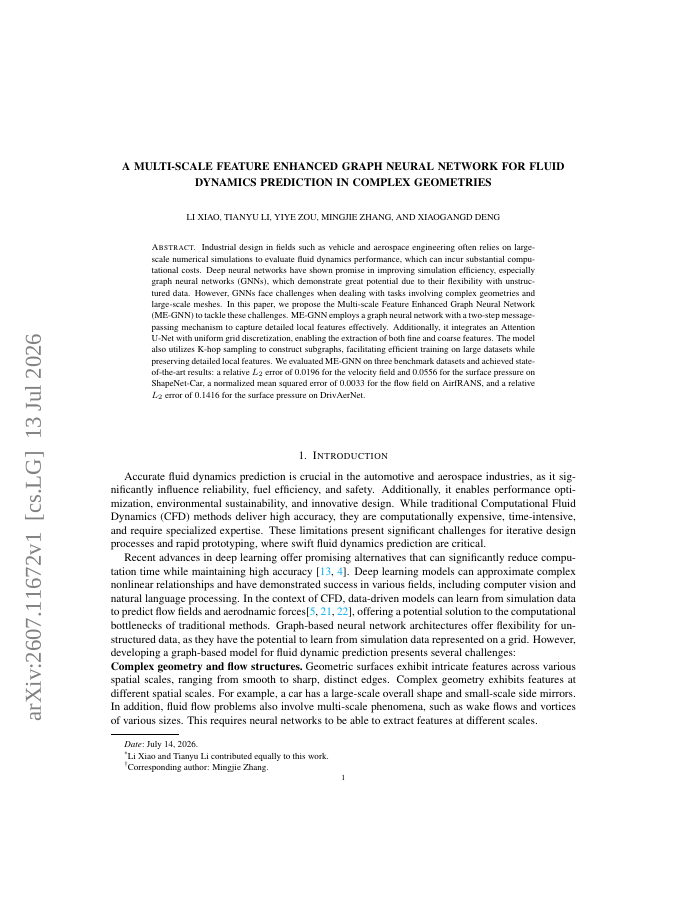
Industrial design in fields such as vehicle and aerospace engineering often relies on large-scale numerical simulations to evaluate fluid dynamics performance, which can incur substantial computational costs. Deep neural networks have shown promise in improving simulation efficiency, especially graph neural networks (GNNs), which demonstrate great potential due to their flexibility with unstructured data. However, GNNs face challenges when dealing with tasks involving complex geometries and large-scale meshes. In this paper, we propose the Multi-scale Feature Enhanced Graph Neural Network (ME-GNN) to tackle these challenges. ME-GNN employs a graph neural network with a two-step message-passing mechanism to capture detailed local features effectively. Additionally, it integrates an Attention U-Net with uniform grid discretization, enabling the extraction of both fine and coarse features. The model also utilizes K-hop sampling to construct subgraphs, facilitating efficient training on large datasets while preserving detailed local features. We evaluated ME-GNN on three benchmark datasets and achieved state-of-the-art results: a relative L2 error of 0.0196 for the velocity field and 0.0556 for the surface pressure on ShapeNet-Car, a normalized mean squared error of 0.0033 for the flow field on AirfRANS, and a relative L2 error of 0.1416 for the surface pressure on DrivAerNet.
A multi-scale feature enhanced graph neural network for fluid dynamics prediction in complex geometries
Industrial design in fields such as vehicle and aerospace engineering often relies on large-scale numerical simulations to evaluate fluid dynamics performance, which can incur substantial computational costs.
- Preview
- Year
- 2026
- Hosting
- Abstract onlyARXIV-DEFAULT
Cite
Notes
Only stored in your browser.
Attribution
- Abstract & full text
- arxiv.org/abs/2607.11672ARXIV-DEFAULT
- TL;DR
- Semantic Scholar