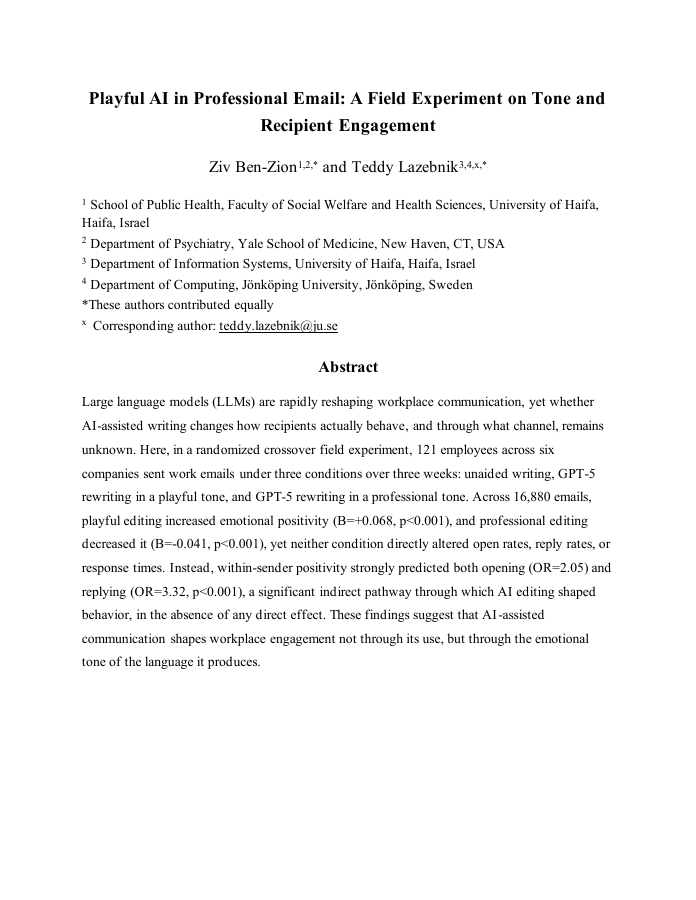
Large language models (LLMs) are rapidly reshaping workplace communication, yet whether AI-assisted writing changes how recipients actually behave, and through what channel, remains unknown. Here, in a randomized crossover field experiment, 121 employees across six companies sent work emails under three conditions over three weeks: unaided writing, GPT-5 rewriting in a playful tone, and GPT-5 rewriting in a professional tone. Across 16,880 emails, playful editing increased emotional positivity (B=+0.068, p<0.001), and professional editing decreased it (B=-0.041, p<0.001), yet neither condition directly altered open rates, reply rates, or response times. Instead, within-sender positivity strongly predicted both opening (OR=2.05) and replying (OR=3.32, p<0.001), a significant indirect pathway through which AI editing shaped behavior, in the absence of any direct effect. These findings suggest that AI-assisted communication shapes workplace engagement not through its use, but through the emotional tone of the language it produces.
Playful AI in Professional Email: A Field Experiment on Tone and Recipient Engagement
Large language models (LLMs) are rapidly reshaping workplace communication, yet whether AI-assisted writing changes how recipients actually behave, and through what channel, remains unknown.
- Preview
- Year
- 2026
- Hosting
- Excerpt onlyCC-BY-NC-SA-4.0
Cite
Notes
Only stored in your browser.
Attribution
- Abstract & full text
- arxiv.org/abs/2607.11749CC-BY-NC-SA-4.0
- TL;DR
- Semantic Scholar