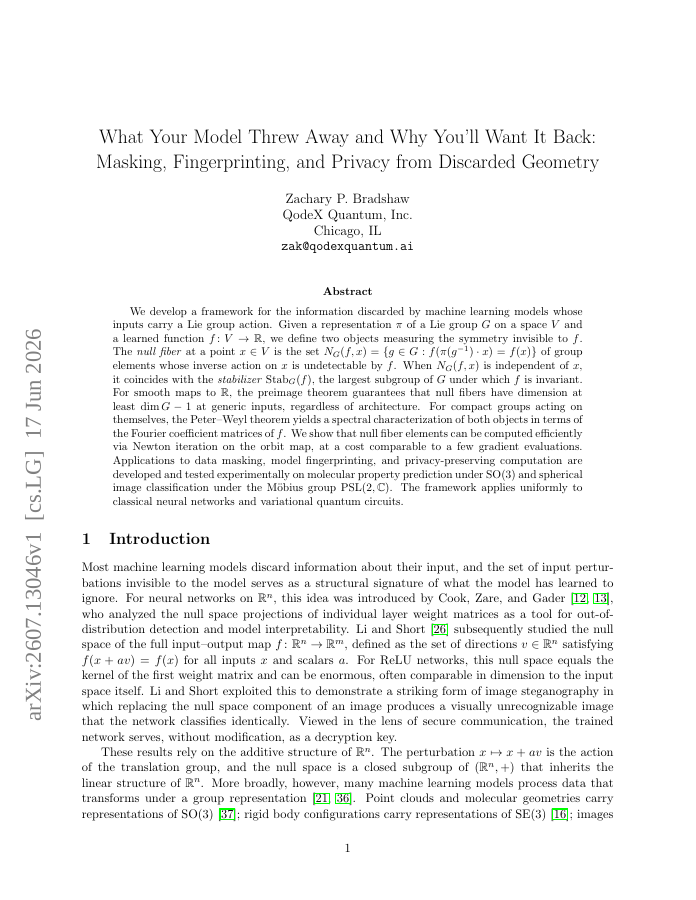
We develop a framework for the information discarded by machine learning models whose inputs carry a Lie group action. Given a representation π of a Lie group G on a space V and a learned function f\colon V \to \mathbb{R}, we define two objects measuring the symmetry invisible to f. The null fiber at a point x \in V is the set N_G(f,x) = {g \in G : f(π(g^{-1}) \cdot x) = f(x)} of group elements whose inverse action on x is undetectable by f. When N_G(f,x) is independent of x, it coincides with the stabilizer Stab_G(f), the largest subgroup of G under which f is invariant. For smooth maps to \mathbb{R}, the preimage theorem guarantees that null fibers have dimension at least \dim G - 1 at generic inputs, regardless of architecture. For compact groups acting on themselves, the Peter--Weyl theorem yields a spectral characterization of both objects in terms of the Fourier coefficient matrices of f. We show that null fiber elements can be computed efficiently via Newton iteration on the orbit map, at a cost comparable to a few gradient evaluations. Applications to data masking, model fingerprinting, and privacy-preserving computation are developed and tested experimentally on molecular property prediction under SO(3) and spherical image classification under the Möbius group PSL(2, \mathbb{C}). The framework applies uniformly to classical neural networks and variational quantum circuits.
What Your Model Threw Away and Why You'll Want It Back: Masking, Fingerprinting, and Privacy from Discarded Geometry
We develop a framework for the information discarded by machine learning models whose inputs carry a Lie group action. Given a representation $π$ of a Lie group $G$ on a space $V$ and a learned function $f\colon V \to \mathbb{R}$, we define two objects measuring the symmetry…
- Preview
- Year
- 2026
- Hosting
- Abstract onlyARXIV-DEFAULT
Cite
Notes
Only stored in your browser.
Attribution
- Abstract & full text
- arxiv.org/abs/2607.13046ARXIV-DEFAULT
- TL;DR
- Semantic Scholar