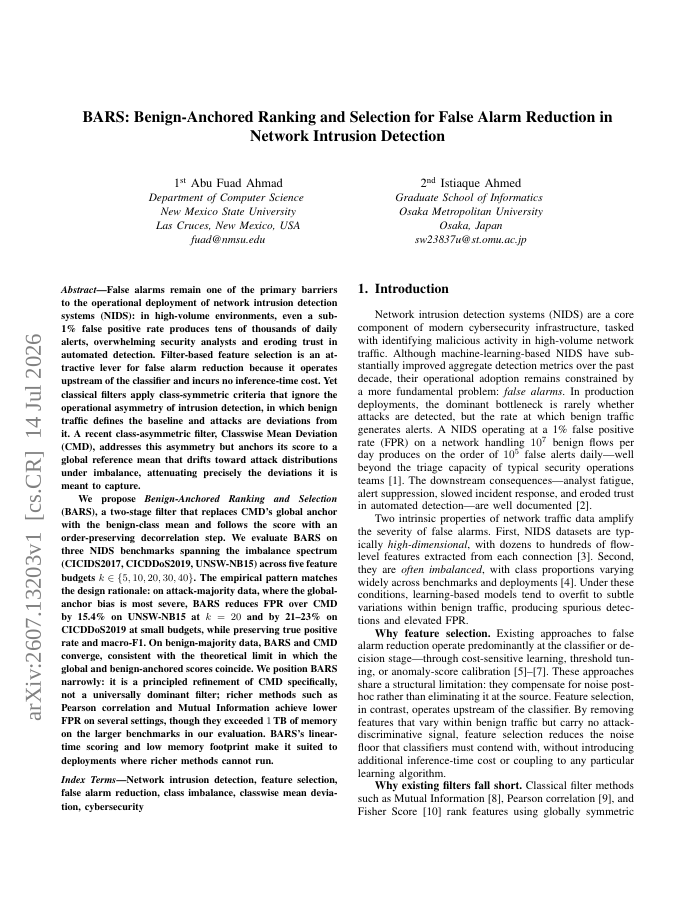
False alarms remain a major barrier to deploying network intrusion detection systems (NIDS). In high-volume environments, even a sub-1% false positive rate can generate tens of thousands of daily alerts. Filter-based feature selection is attractive because it operates upstream of the classifier and adds no inference-time cost. However, classical filters use class-symmetric criteria that ignore the asymmetry of intrusion detection, where benign traffic defines the baseline and attacks are deviations from it. A recent class-asymmetric filter, Classwise Mean Deviation (CMD), addresses this issue but anchors its score to a global mean that shifts toward attack distributions under class imbalance, weakening the deviations it aims to capture. We propose Benign-Anchored Ranking and Selection (BARS), a two-stage filter that replaces CMD's global anchor with the benign-class mean and applies an order-preserving decorrelation step. We evaluate BARS on CICIDS2017, CICDDoS2019, and UNSW-NB15 using feature budgets k = {5, 10, 20, 30, 40}. On attack-majority datasets, where global-anchor bias is strongest, BARS reduces false positive rate relative to CMD by 15.4% on UNSW-NB15 at k = 20 and by 21% to 23% on CICDDoS2019 at small feature budgets while preserving true positive rate and macro-F1. On benign-majority data, BARS and CMD converge, consistent with the theoretical limit where global- and benign-anchored scores coincide. BARS is a principled refinement of CMD rather than a universally dominant filter. Although Pearson Correlation and Mutual Information often achieve lower false positive rates, they exceeded 1 TB of memory on the largest benchmarks in our evaluation. BARS retains linear-time scoring and a low memory footprint, making it suitable for resource-constrained deployments.
BARS: Benign-Anchored Ranking and Selection for False Alarm Reduction in Network Intrusion Detection
False alarms remain a major barrier to deploying network intrusion detection systems (NIDS). In high-volume environments, even a sub-1% false positive rate can generate tens of thousands of daily alerts.
- Preview
- Year
- 2026
- Hosting
- Full text hostedCC-BY-4.0
Cite
Notes
Only stored in your browser.
Attribution
- Abstract & full text
- arxiv.org/abs/2607.13203CC-BY-4.0
- TL;DR
- Semantic Scholar