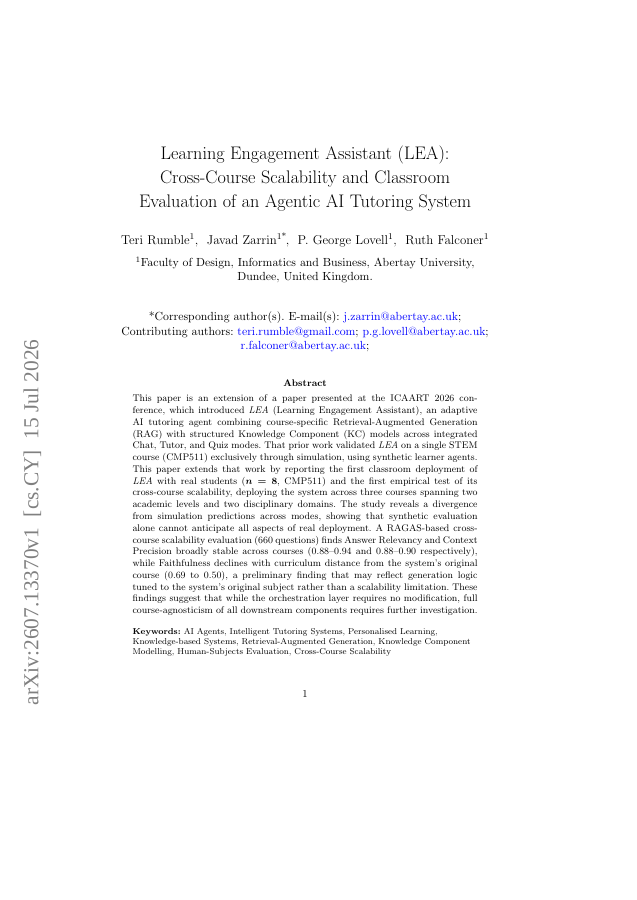
This paper is an extension of a paper presented at the ICAART 2026 conference, which introduced LEA (Learning Engagement Assistant), an adaptive AI tutoring agent combining course-specific Retrieval-Augmented Generation (RAG) with structured Knowledge Component (KC) models across integrated Chat, Tutor, and Quiz modes. That prior work validated LEA on a single STEM course (CMP511) exclusively through simulation, using synthetic learner agents. This paper extends that work by reporting the first classroom deployment of LEA with real students (n = 8, CMP511) and the first empirical test of its cross-course scalability, deploying the system across three courses spanning two academic levels and two disciplinary domains. The study reveals a divergence from simulation predictions across modes, showing that synthetic evaluation alone cannot anticipate all aspects of real deployment. A RAGAS-based cross-course scalability evaluation (660 questions) finds Answer Relevancy and Context Precision broadly stable across courses (0.88-0.94 and 0.88-0.90 respectively), while Faithfulness declines with curriculum distance from the system's original course (0.69 to 0.50), a preliminary finding that may reflect generation logic tuned to the system's original subject rather than a scalability limitation. These findings suggest that while the orchestration layer requires no modification, full course-agnosticism of all downstream components requires further investigation.
Learning Engagement Assistant (LEA): Cross-Course Scalability and Classroom Evaluation of an Agentic AI Tutoring System
This paper is an extension of a paper presented at the ICAART 2026 conference, which introduced LEA (Learning Engagement Assistant), an adaptive AI tutoring agent combining course-specific Retrieval-Augmented Generation (RAG) with structured Knowledge Component (KC) models…
- Preview
- Year
- 2026
- Hosting
- Abstract onlyARXIV-DEFAULT
Cite
Notes
Only stored in your browser.
Attribution
- Abstract & full text
- arxiv.org/abs/2607.13370ARXIV-DEFAULT
- TL;DR
- Semantic Scholar