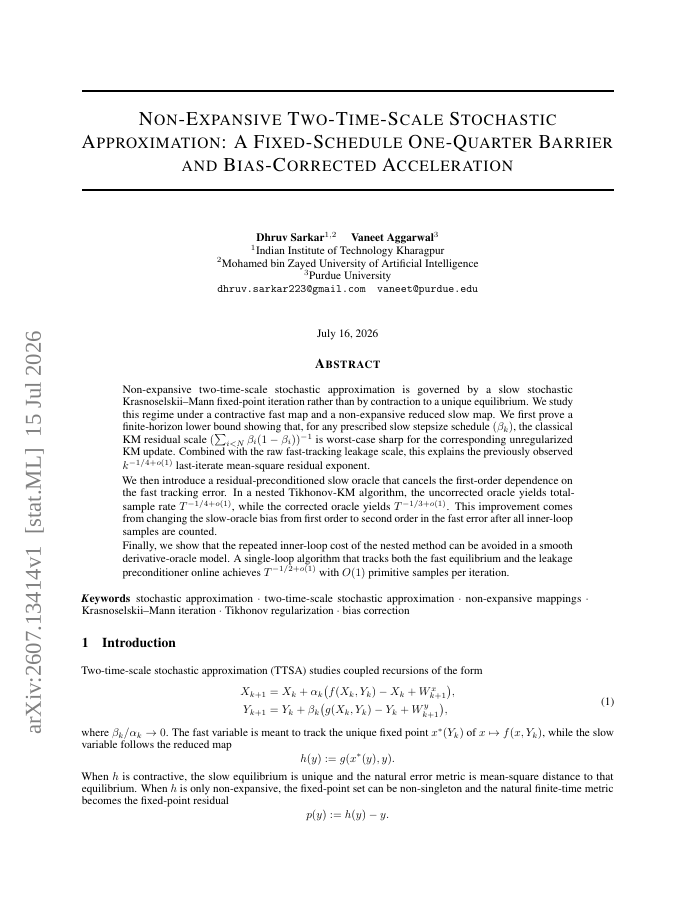
Non-expansive two-time-scale stochastic approximation is governed by a slow stochastic Krasnoselskii--Mann fixed-point iteration rather than by contraction to a unique equilibrium. We study this regime under a contractive fast map and a non-expansive reduced slow map. We first prove a finite-horizon lower bound showing that, for any prescribed slow stepsize schedule (β_k), the classical KM residual scale (\sum_{i<N}β_i(1-β_i))^{-1} is worst-case sharp for the corresponding unregularized KM update. Combined with the raw fast-tracking leakage scale, this explains the previously observed k^{-1/4+o(1)} last-iterate mean-square residual exponent. We then introduce a residual-preconditioned slow oracle that cancels the first-order dependence on the fast tracking error. In a nested Tikhonov-KM algorithm, the uncorrected oracle yields total-sample rate T^{-1/4+o(1)}, while the corrected oracle yields T^{-1/3+o(1)}. This improvement comes from changing the slow-oracle bias from first order to second order in the fast error after all inner-loop samples are counted. Finally, we show that the repeated inner-loop cost of the nested method can be avoided in a smooth derivative-oracle model. A single-loop algorithm that tracks both the fast equilibrium and the leakage preconditioner online achieves T^{-1/2+o(1)} with O(1) primitive samples per iteration.
Non-Expansive Two-Time-Scale Stochastic Approximation: A Fixed-Schedule One-Quarter Barrier and Bias-Corrected Acceleration
Non-expansive two-time-scale stochastic approximation is governed by a slow stochastic Krasnoselskii--Mann fixed-point iteration rather than by contraction to a unique equilibrium. We study this regime under a contractive fast map and a non-expansive reduced slow map.
- Preview
- Year
- 2026
- Hosting
- Full text hostedCC-BY-4.0
Cite
Notes
Only stored in your browser.
Attribution
- Abstract & full text
- arxiv.org/abs/2607.13414CC-BY-4.0
- TL;DR
- Semantic Scholar