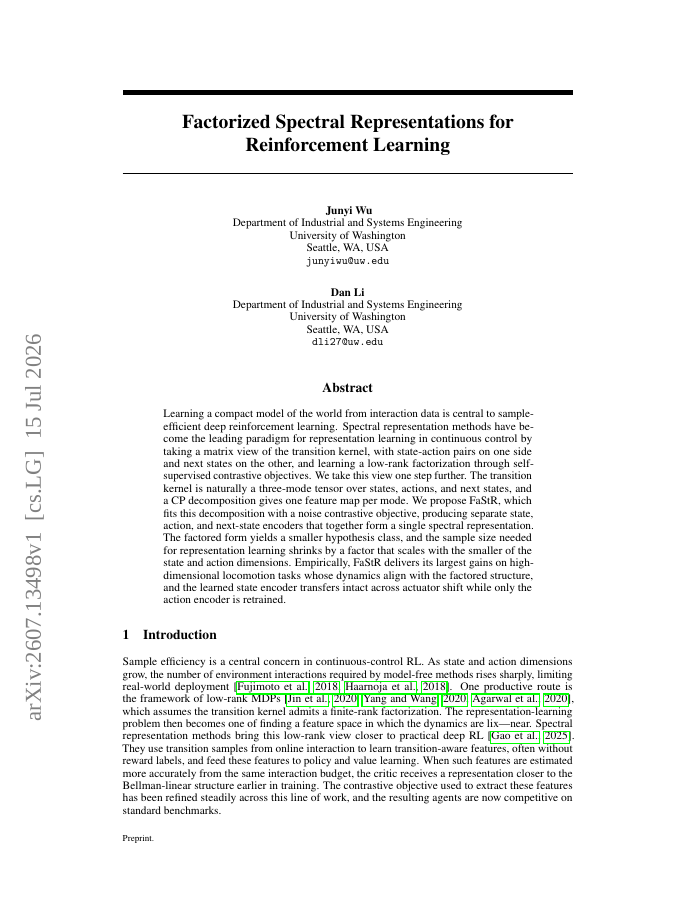
Learning a compact model of the world from interaction data is central to sample-efficient deep reinforcement learning. Spectral representation methods have become the leading paradigm for representation learning in continuous control by taking a matrix view of the transition kernel, with state-action pairs on one side and next states on the other, and learning a low-rank factorization through self-supervised contrastive objectives. We take this view one step further. The transition kernel is naturally a three-mode tensor over states, actions, and next states, and a CP decomposition gives one feature map per mode. We propose FaStR, which fits this decomposition with a noise contrastive objective, producing separate state, action, and next-state encoders that together form a single spectral representation. The factored form yields a smaller hypothesis class, and the sample size needed for representation learning shrinks by a factor that scales with the smaller of the state and action dimensions. Empirically, FaStR delivers its largest gains on high-dimensional locomotion tasks whose dynamics align with the factored structure, and the learned state encoder transfers intact across actuator shift while only the action encoder is retrained.
Factorized Spectral Representations for Reinforcement Learning
Learning a compact model of the world from interaction data is central to sample-efficient deep reinforcement learning. Spectral representation methods have become the leading paradigm for representation learning in continuous control by taking a matrix view of the transition…
- Preview
- Year
- 2026
- Hosting
- Abstract onlyARXIV-DEFAULT
Cite
Notes
Only stored in your browser.
Attribution
- Abstract & full text
- arxiv.org/abs/2607.13498ARXIV-DEFAULT
- TL;DR
- Semantic Scholar