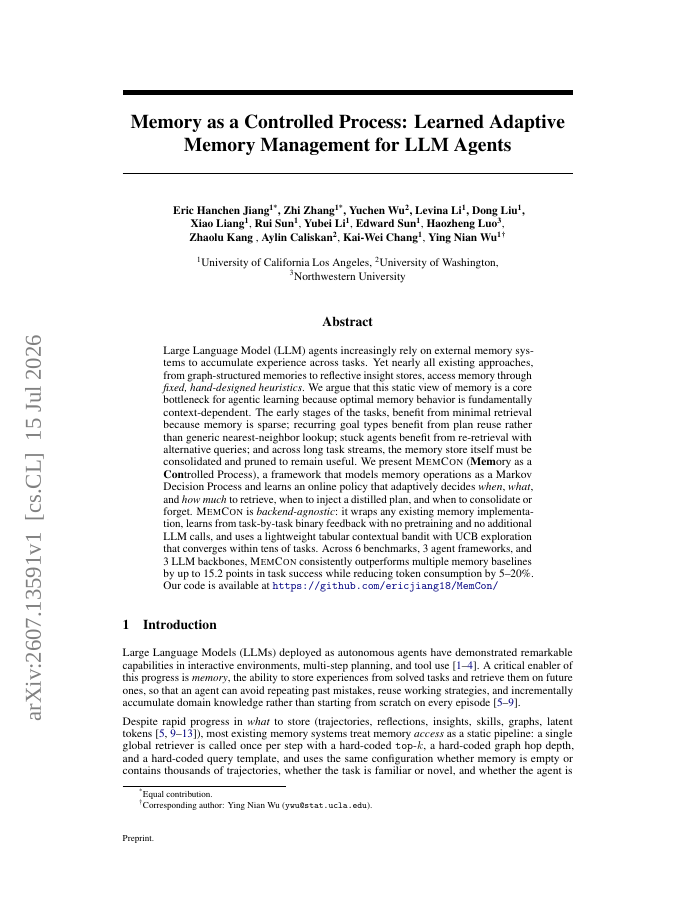
Large Language Model (LLM) agents increasingly rely on external memory systems to accumulate experience across tasks. Yet nearly all existing approaches, from graph-structured memories to reflective insight stores, access memory through fixed, hand-designed heuristics. We argue that this static view of memory is a core bottleneck for agentic learning because optimal memory behavior is fundamentally context-dependent. The early stages of the tasks, benefit from minimal retrieval because memory is sparse; recurring goal types benefit from plan reuse rather than generic nearest-neighbor lookup; stuck agents benefit from re-retrieval with alternative queries; and across long task streams, the memory store itself must be consolidated and pruned to remain useful. We present Memory as a Controlled Process (MemCon), a framework that models memory operations as a Markov Decision Process and learns an online policy that adaptively decides when, what, and how much to retrieve, when to inject a distilled plan, and when to consolidate or forget. MemCon is backend-agnostic: it wraps any existing memory implementation, learns from task-by-task binary feedback with no pretraining and no additional LLM calls, and uses a lightweight tabular contextual bandit with UCB exploration that converges within tens of tasks. Across 6 benchmarks, 3 agent frameworks, and 3 LLM backbones, MemCon consistently outperforms multiple memory baselines by up to 15.2 points in task success while reducing token consumption by 5--20%.
Memory as a Controlled Process: Learned Adaptive Memory Management for LLM Agents
Large Language Model (LLM) agents increasingly rely on external memory systems to accumulate experience across tasks. Yet nearly all existing approaches, from graph-structured memories to reflective insight stores, access memory through fixed, hand-designed heuristics.
- Preview
- Year
- 2026
- Hosting
- Full text hostedCC-BY-4.0
Cite
Notes
Only stored in your browser.
Attribution
- Abstract & full text
- arxiv.org/abs/2607.13591CC-BY-4.0
- TL;DR
- Semantic Scholar