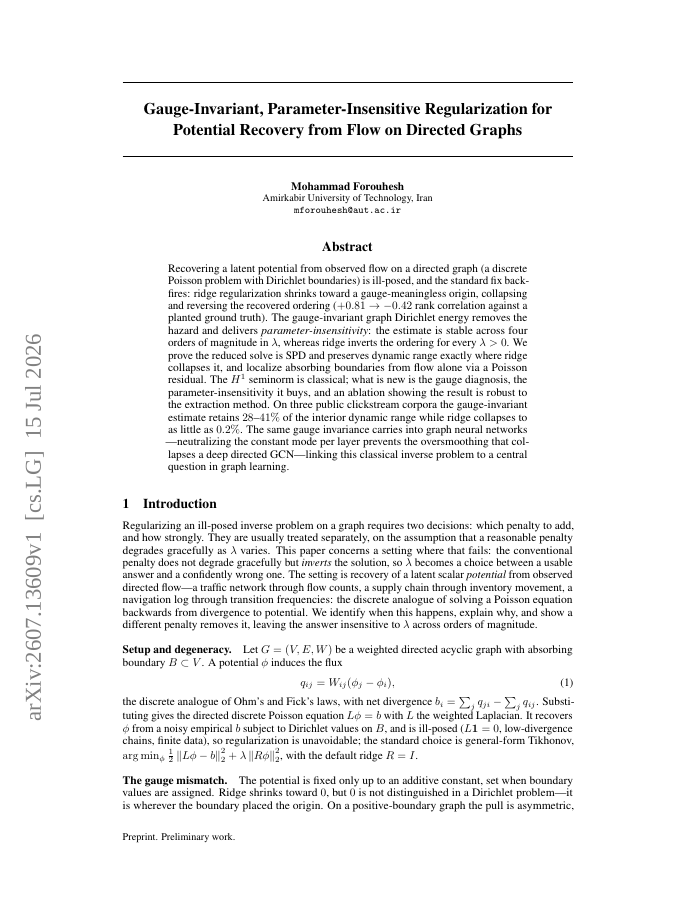
Recovering a latent potential from observed flow on a directed graph (a discrete Poisson problem with Dirichlet boundaries) is ill-posed, and the standard fix backfires: ridge regularization shrinks toward a gauge-meaningless origin, collapsing and reversing the recovered ordering (+0.81\to-0.42 rank correlation against a planted ground truth). The gauge-invariant graph Dirichlet energy removes the hazard and delivers parameter-insensitivity: the estimate is stable across four orders of magnitude in λ, whereas ridge inverts the ordering for every λ>0. We prove the reduced solve is SPD and preserves dynamic range exactly where ridge collapses it, and localize absorbing boundaries from flow alone via a Poisson residual. The H^1 seminorm is classical; what is new is the gauge diagnosis, the parameter-insensitivity it buys, and an ablation showing the result is robust to the extraction method. On three public clickstream corpora the gauge-invariant estimate retains 28--41% of the interior dynamic range while ridge collapses to as little as 0.2%. The same gauge invariance carries into graph neural networks -- neutralizing the constant mode per layer prevents the oversmoothing that collapses a deep directed GCN -- linking this classical inverse problem to a central question in graph learning.
Gauge-Invariant, Parameter-Insensitive Regularization for Potential Recovery from Flow on Directed Graphs
Recovering a latent potential from observed flow on a directed graph (a discrete Poisson problem with Dirichlet boundaries) is ill-posed, and the standard fix backfires: ridge regularization shrinks toward a gauge-meaningless origin, collapsing and reversing the recovered…
- Preview
- Year
- 2026
- Hosting
- Full text hostedCC-BY-4.0
Cite
Notes
Only stored in your browser.
Attribution
- Abstract & full text
- arxiv.org/abs/2607.13609CC-BY-4.0
- TL;DR
- Semantic Scholar