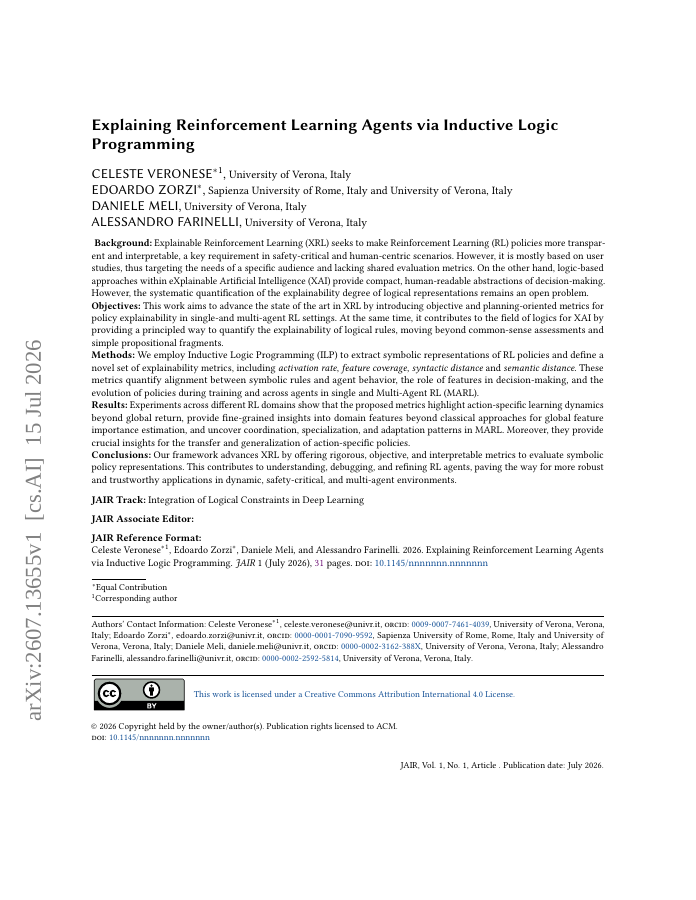
Explainable Reinforcement Learning (XRL) seeks to make Reinforcement Learning (RL) policies more transparent and interpretable, a key requirement in safety-critical and human-centric scenarios. However, it is mostly based on user studies, thus targeting the needs of a specific audience and lacking shared evaluation metrics. On the other hand, logic-based approaches within eXplainable Artificial Intelligence (XAI) provide compact, human-readable abstractions of decision-making. However, the systematic quantification of the explainability degree of logical representations remains an open problem. This work aims to advance the state of the art in XRL by introducing objective and planning-oriented metrics for policy explainability in RL settings. At the same time, it contributes to the field of logic for XAI by providing a principled way to quantify the explainability of logical rules, moving beyond common-sense assessments and simple propositional fragments. We employ Inductive Logic Programming (ILP) to extract symbolic representations of RL policies and define a novel set of explainability metrics, including activation rate, feature coverage, syntactic distance and semantic distance. These metrics quantify alignment between symbolic rules and agent behavior, the role of features in decision-making, and the evolution of policies during training and across agents in single and multi-agent RL. Experiments across different RL domains show that the proposed metrics highlight action-specific learning dynamics beyond global return, provide fine-grained insights into domain features beyond classical approaches for global feature importance estimation, and uncover coordination, specialization, and adaptation patterns in MARL. Moreover, they provide crucial insights for the transfer and generalization of action-specific policies.
Explaining Reinforcement Learning Agents via Inductive Logic Programming
Explainable Reinforcement Learning (XRL) seeks to make Reinforcement Learning (RL) policies more transparent and interpretable, a key requirement in safety-critical and human-centric scenarios.
- Preview
- Year
- 2026
- Hosting
- Full text hostedCC-BY-4.0
Cite
Notes
Only stored in your browser.
Attribution
- Abstract & full text
- arxiv.org/abs/2607.13655CC-BY-4.0
- TL;DR
- Semantic Scholar