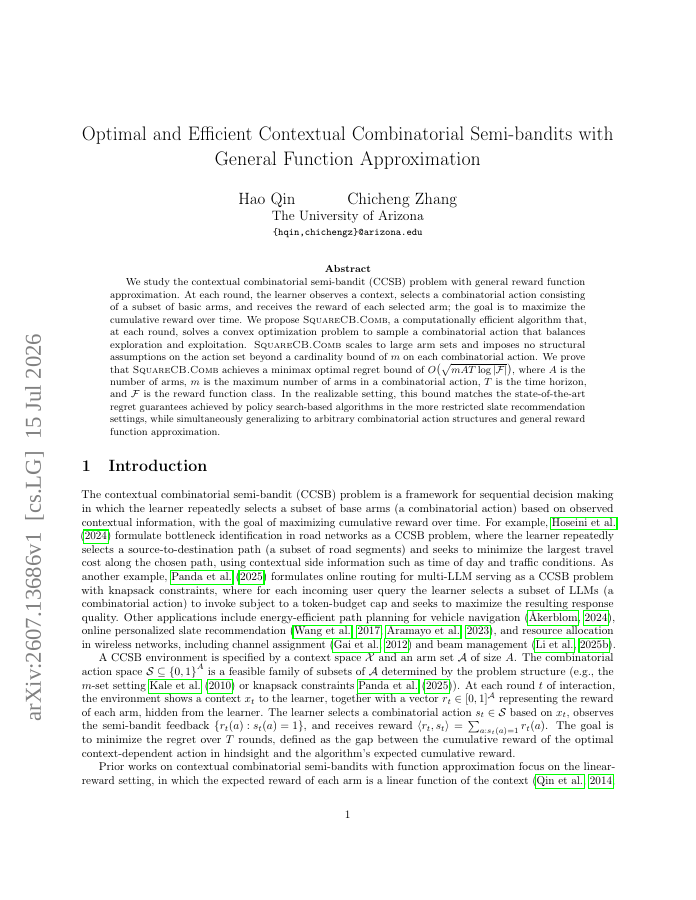
We study the contextual combinatorial semi-bandit (CCSB) problem with general reward function approximation. At each round, the learner observes a context, selects a combinatorial action consisting of a subset of basic arms, and receives the reward of each selected arm; the goal is to maximize the cumulative reward over time. We propose SquareCB.Comb, a computationally efficient algorithm that, at each round, solves a convex optimization problem to sample a combinatorial action that balances exploration and exploitation. SquareCB.Comb scales to large arm sets and imposes no structural assumptions on the action set beyond a cardinality bound of m on each combinatorial action. We prove that SquareCB.Comb achieves a minimax optimal regret bound of O(\sqrt{m A T \log |F|}), where A is the number of arms, m is the maximum number of arms in a combinatorial action, T is the time horizon, and F is the reward function class. In the realizable setting, this bound matches the state-of-the-art regret guarantees achieved by policy search-based algorithms in the more restricted slate recommendation settings, while simultaneously generalizing to arbitrary combinatorial action structures and general reward function approximation.
Optimal and Efficient Contextual Combinatorial Semi-bandits with General Function Approximation
We study the contextual combinatorial semi-bandit (CCSB) problem with general reward function approximation. At each round, the learner observes a context, selects a combinatorial action consisting of a subset of basic arms, and receives the reward of each selected arm; the goal…
- Preview
- Year
- 2026
- Hosting
- Abstract onlyARXIV-DEFAULT
Cite
Notes
Only stored in your browser.
Attribution
- Abstract & full text
- arxiv.org/abs/2607.13686ARXIV-DEFAULT
- TL;DR
- Semantic Scholar