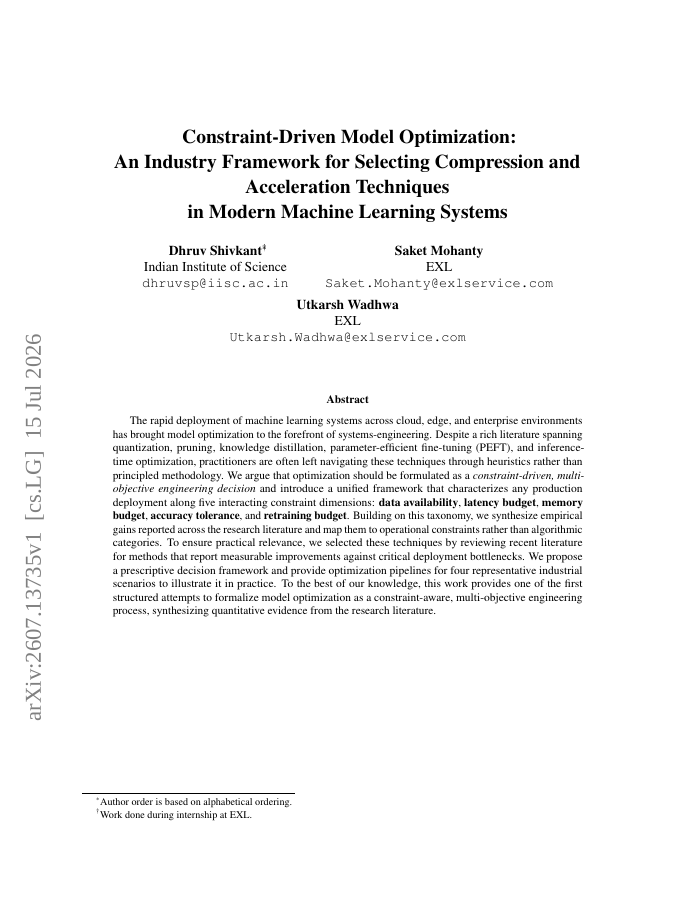
The rapid deployment of machine learning systems across cloud, edge, and enterprise environments has brought model optimization to the forefront of systems-engineering. Despite a rich literature spanning quantization, pruning, knowledge distillation, parameter-efficient fine-tuning (PEFT), and inference-time optimization, practitioners are often left navigating these techniques through heuristics rather than principled methodology. We argue that optimization should be formulated as a constraint-driven, multi-objective engineering decision and introduce a unified framework that characterizes any production deployment along five interacting constraint dimensions: data availability, latency budget, memory budget, accuracy tolerance, and retraining budget. Building on this taxonomy, we synthesize empirical gains reported across the research literature and map them to operational constraints rather than algorithmic categories. To ensure practical relevance, we selected these techniques by reviewing recent literature for methods that report measurable improvements against critical deployment bottlenecks. We propose a prescriptive decision framework and provide optimization pipelines for four representative industrial scenarios to illustrate it in practice. To the best of our knowledge, this work provides one of the first structured attempts to formalize model optimization as a constraint-aware, multi-objective engineering process, synthesizing quantitative evidence from the research literature.
Constraint-Driven Model Optimization: An Industry Framework for Selecting Compression and Acceleration Techniques in Modern Machine Learning Systems
The rapid deployment of machine learning systems across cloud, edge, and enterprise environments has brought model optimization to the forefront of systems-engineering. Despite a rich literature spanning quantization, pruning, knowledge distillation, parameter-efficient…
- Preview
- Year
- 2026
- Hosting
- Full text hostedCC-BY-4.0
Cite
Notes
Only stored in your browser.
Attribution
- Abstract & full text
- arxiv.org/abs/2607.13735CC-BY-4.0
- TL;DR
- Semantic Scholar