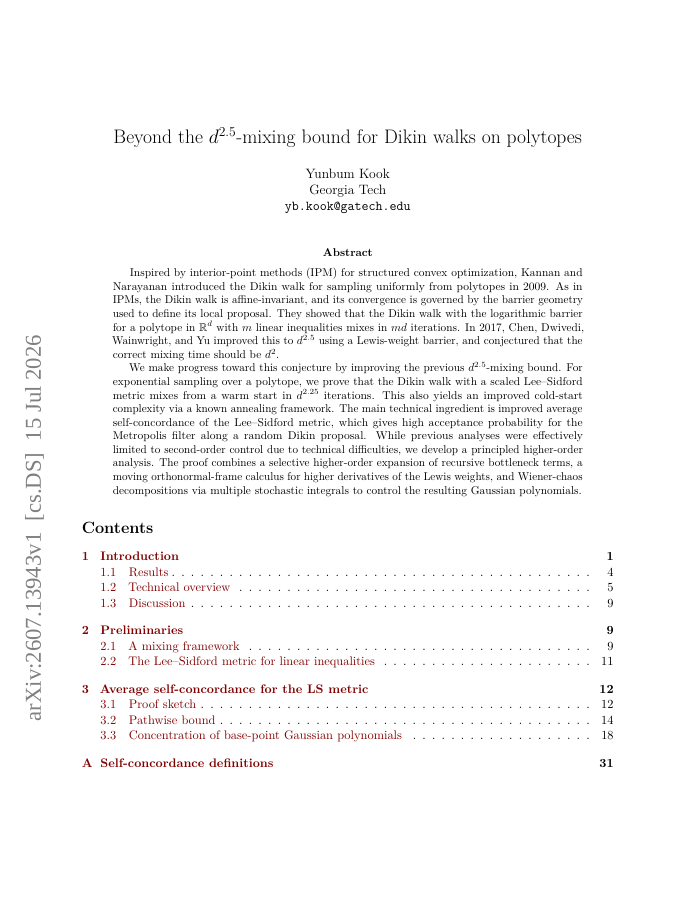
Inspired by interior-point methods (IPM) for structured convex optimization, Kannan and Narayanan introduced the Dikin walk for sampling uniformly from polytopes in 2009. As in IPMs, the Dikin walk is affine-invariant, and its convergence is governed by the barrier geometry used to define its local proposal. They showed that the Dikin walk with the logarithmic barrier for a polytope in \mathbb{R}^{d} with m linear inequalities mixes in md iterations. In 2017, Chen, Dwivedi, Wainwright, and Yu improved this to d^{2.5} using a Lewis-weight barrier, and conjectured that the correct mixing time should be d^{2}. We make progress toward this conjecture by improving the previous d^{2.5}-mixing bound. For exponential sampling over a polytope, we prove that the Dikin walk with a scaled Lee--Sidford metric mixes from a warm start in d^{2.25} iterations. This also yields an improved cold-start complexity via a known annealing framework. The main technical ingredient is improved average self-concordance of the Lee--Sidford metric, which gives high acceptance probability for the Metropolis filter along a random Dikin proposal. While previous analyses were effectively limited to second-order control due to technical difficulties, we develop a principled higher-order analysis. The proof combines a selective higher-order expansion of recursive bottleneck terms, a moving orthonormal-frame calculus for higher derivatives of the Lewis weights, and Wiener-chaos decompositions via multiple stochastic integrals to control the resulting Gaussian polynomials.
Beyond the $d^{2.5}$-mixing bound for Dikin walks on polytopes
Inspired by interior-point methods (IPM) for structured convex optimization, Kannan and Narayanan introduced the Dikin walk for sampling uniformly from polytopes in 2009.
- Preview
- Year
- 2026
- Hosting
- Full text hostedCC-BY-4.0
Cite
Notes
Only stored in your browser.
Attribution
- Abstract & full text
- arxiv.org/abs/2607.13943CC-BY-4.0
- TL;DR
- Semantic Scholar