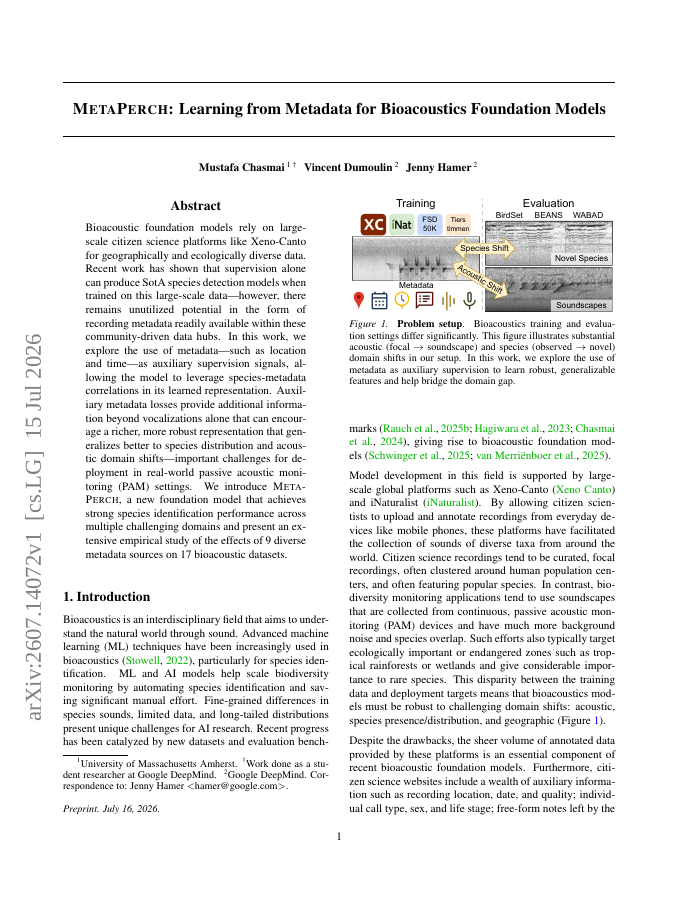
Bioacoustic foundation models rely on large-scale citizen science platforms like Xeno-Canto for geographically and ecologically diverse data. Recent work has shown that supervision alone can produce SotA species detection models when trained on this large-scale data -- however, there remains unutilized potential in the form of recording metadata readily available within these community-driven data hubs. In this work, we explore the use of metadata -- such as location and time -- as auxiliary supervision signals, allowing the model to leverage species-metadata correlations in its learned representation. Auxiliary metadata losses provide additional information beyond vocalizations alone that can encourage a richer, more robust representation that generalizes better to species distribution and acoustic domain shifts -- important challenges for deployment in real-world passive acoustic monitoring (PAM) settings. We introduce MetaPerch, a new foundation model that achieves strong species identification performance across multiple challenging domains and present an extensive empirical study of the effects of 9 diverse metadata sources on 17 bioacoustic datasets.
MetaPerch: Learning from metadata for bioacoustics foundation models
Bioacoustic foundation models rely on large-scale citizen science platforms like Xeno-Canto for geographically and ecologically diverse data. Recent work has shown that supervision alone can produce SotA species detection models when trained on this large-scale data -- however,…
- Preview
- Year
- 2026
- Hosting
- Full text hostedCC-BY-4.0
Cite
Notes
Only stored in your browser.
Attribution
- Abstract & full text
- arxiv.org/abs/2607.14072CC-BY-4.0
- TL;DR
- Semantic Scholar