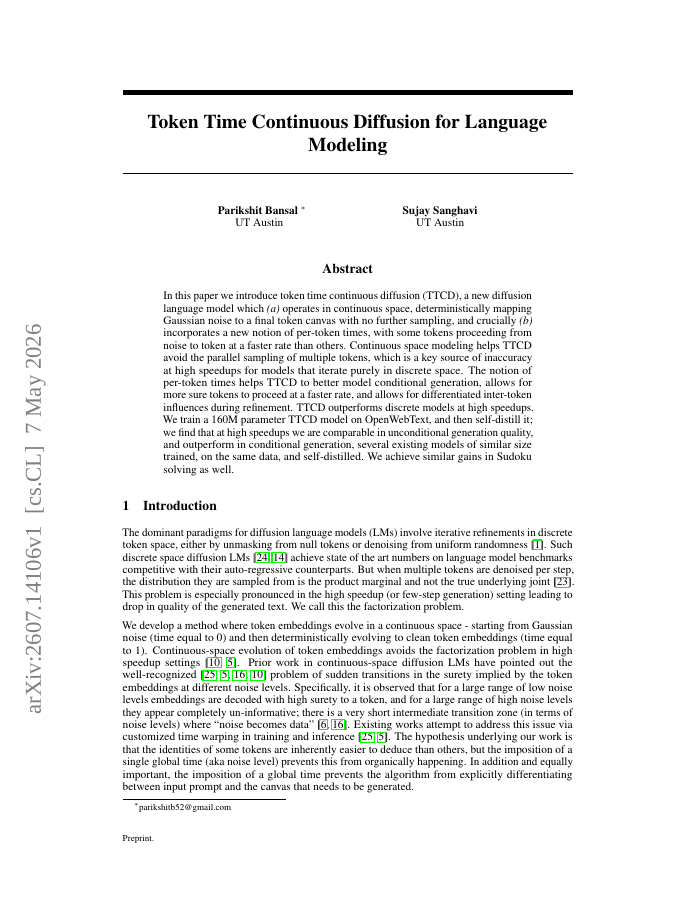
In this paper we introduce token time continuous diffusion (TTCD), a new diffusion language model which (a) operates in continuous space, deterministically mapping Gaussian noise to a final token canvas with no further sampling, and crucially (b) incorporates a new notion of per-token times, with some tokens proceeding from noise to token at a faster rate than others. Continuous space modeling helps TTCD avoid the parallel sampling of multiple tokens, which is a key source of inaccuracy at high speedups for models that iterate purely in discrete space. The notion of per-token times helps TTCD to better model conditional generation, allows for more sure tokens to proceed at a faster rate, and allows for differentiated inter-token influences during refinement. TTCD outperforms discrete models at high speedups. We train a 160M parameter TTCD model on OpenWebText, and then self-distill it; we find that at high speedups we are comparable in unconditional generation quality, and outperform in conditional generation, several existing models of similar size trained, on the same data, and self-distilled. We achieve similar gains in Sudoku solving as well.
Token Time Continuous Diffusion for Language Modeling
In this paper we introduce token time continuous diffusion (TTCD), a new diffusion language model which (a) operates in continuous space, deterministically mapping Gaussian noise to a final token canvas with no further sampling, and crucially (b) incorporates a new notion of…
- Preview
- Year
- 2026
- Hosting
- Full text hostedCC-BY-4.0
Cite
Notes
Only stored in your browser.
Attribution
- Abstract & full text
- arxiv.org/abs/2607.14106CC-BY-4.0
- TL;DR
- Semantic Scholar