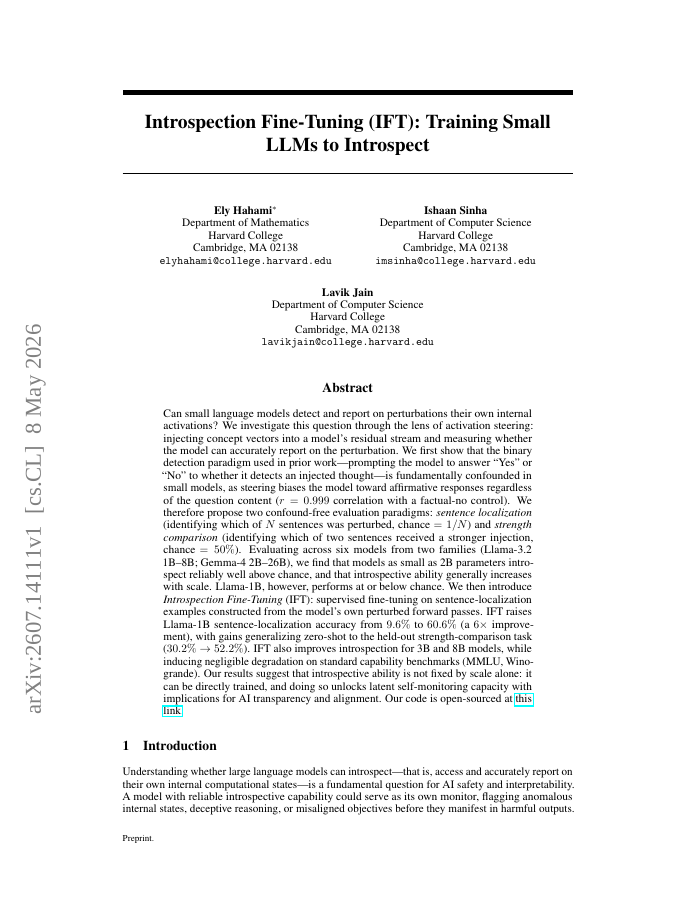
Can small language models detect and report on perturbations their own internal activations? We investigate this question through the lens of activation steering: injecting concept vectors into a model's residual stream and measuring whether the model can accurately report on the perturbation. We first show that the binary detection paradigm used in prior work -- prompting the model to answer Yes'' or No'' to whether it detects an injected thought -- is confounded in small models, as steering biases the model toward affirmative responses regardless of the question content. We therefore propose two confound-free evaluation paradigms: sentence localization (identifying which of N sentences was perturbed, chance = 1/N) and strength comparison (identifying which of two sentences received a stronger injection, chance = 50%). Evaluating across six models from two families (Llama-3.2 and Gemma-4), we find that models as small as 2B parameters introspect reliably well above chance, and that introspective ability generally increases with scale. Llama-1B, however, performs at or below chance. We then introduce Introspection Fine-Tuning (IFT): supervised fine-tuning on sentence-localization examples constructed from the model's own perturbed forward passes. IFT raises Llama-1B sentence-localization accuracy from 9.6% to 60.6% (a 6\times improvement), with gains generalizing zero-shot to the held-out strength-comparison task (30.2% \to 52.2%). IFT also improves introspection for 3B and 8B models, while inducing negligible degradation on standard capability benchmarks. Our results suggest that introspective ability is not fixed by scale alone: it can be directly trained, and doing so unlocks latent self-monitoring capacity with implications for AI transparency and alignment. Our code is here.
Introspection Fine-Tuning (IFT): Training Small LLMs to Introspect
Can small language models detect and report on perturbations their own internal activations? We investigate this question through the lens of activation steering: injecting concept vectors into a model's residual stream and measuring whether the model can accurately report on…
- Preview
- Year
- 2026
- Hosting
- Full text hostedCC-BY-4.0
Cite
Notes
Only stored in your browser.
Attribution
- Abstract & full text
- arxiv.org/abs/2607.14111CC-BY-4.0
- TL;DR
- Semantic Scholar