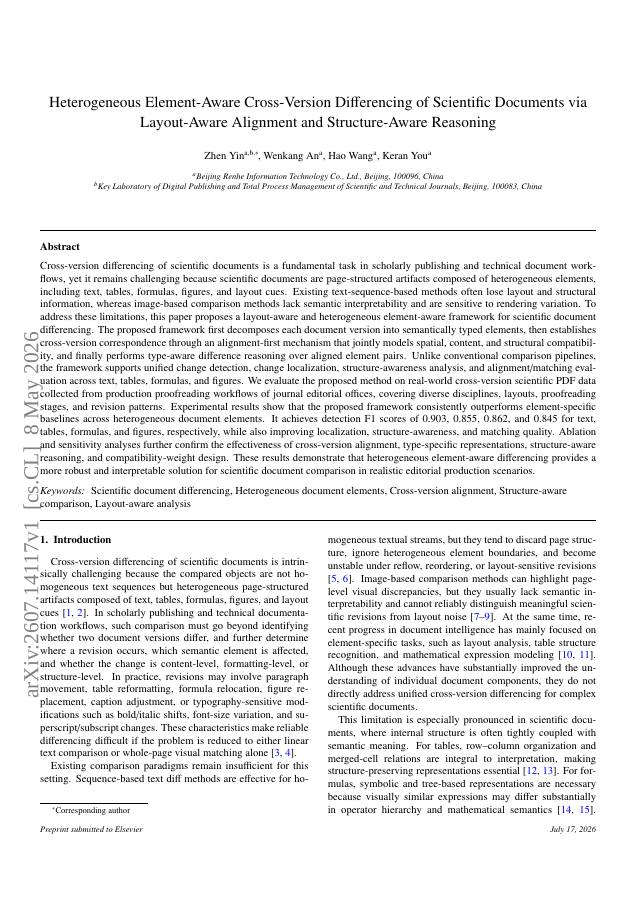
Cross-version differencing of scientific documents is essential in scholarly publishing and technical documentation, but remains challenging because scientific documents are page-structured artifacts containing heterogeneous elements such as text, tables, formulas, figures, and layout cues. Existing text-sequence-based methods often lose layout and structural information, while image-based methods lack semantic interpretability and are sensitive to rendering variation. To address these limitations, this paper proposes a layout-aware heterogeneous element-aware framework for scientific document differencing. The framework decomposes document versions into semantically typed elements, establishes cross-version correspondence through an alignment-first mechanism that jointly models spatial, content, and structural compatibility, and performs type-aware difference reasoning over aligned element pairs. It supports unified change detection, localization, structure-awareness analysis, and alignment/matching evaluation across text, tables, formulas, and figures. Experiments on real-world scientific PDF data from journal production proofreading workflows show that the proposed framework consistently outperforms element-specific baselines. It achieves detection F1 scores of 0.903, 0.855, 0.862, and 0.845 for text, tables, formulas, and figures, respectively, with further improvements in localization, structure awareness, and matching quality. Ablation and sensitivity analyses confirm the effectiveness of cross-version alignment, type-specific representations, structure-aware reasoning, and compatibility-weight design. These results demonstrate that heterogeneous element-aware differencing provides a robust and interpretable solution for scientific document comparison in realistic editorial production scenarios.
Heterogeneous Element-Aware Cross-Version Differencing of Scientific Documents via Layout-Aware Alignment and Structure-Aware Reasoning
Cross-version differencing of scientific documents is essential in scholarly publishing and technical documentation, but remains challenging because scientific documents are page-structured artifacts containing heterogeneous elements such as text, tables, formulas, figures, and…
- Preview
- Year
- 2026
- Hosting
- Excerpt onlyCC-BY-NC-SA-4.0
Cite
Notes
Only stored in your browser.
Attribution
- Abstract & full text
- arxiv.org/abs/2607.14117CC-BY-NC-SA-4.0
- TL;DR
- Semantic Scholar