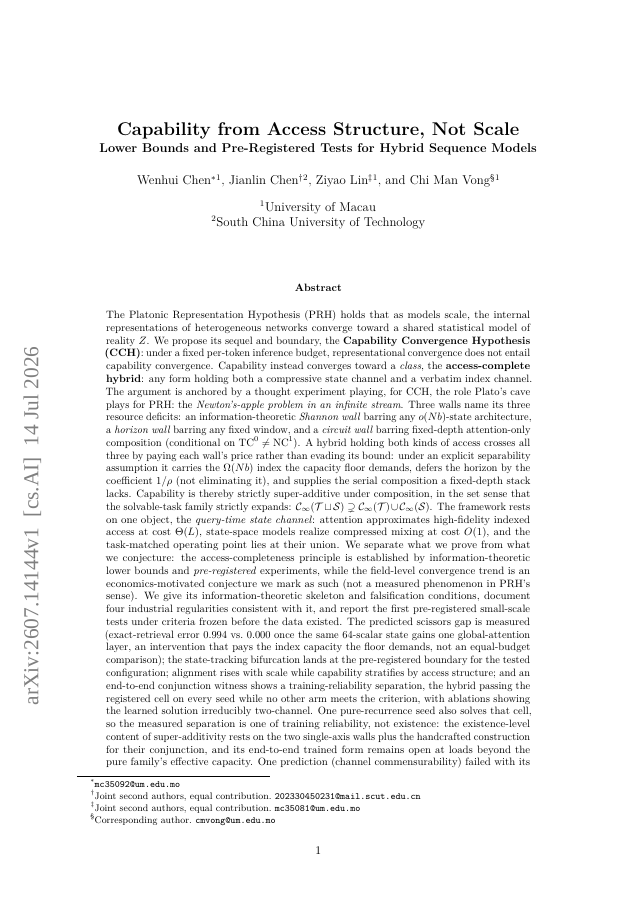
The Platonic Representation Hypothesis (PRH) holds that as models scale, representations of heterogeneous networks converge toward a shared model of reality. We propose its sequel and boundary, the Capability Convergence Hypothesis (CCH): under a fixed per-token inference budget, representational convergence does not entail capability convergence. Capability instead converges toward a class, the access-complete hybrid: any architecture holding both a compressive O(1)-state channel and a scalable verbatim-index channel. We anchor it on a witness task, the Newton's-apple problem in an infinite stream, and name three resource walls: a Shannon wall barring any o(Nb)-state architecture, a horizon wall barring any fixed window, and a circuit wall barring fixed-depth attention-only composition (conditional on TC0 != NC1). Under an explicit separability assumption a hybrid crosses all three by paying each wall's price, so capability is strictly super-additive under composition. We separate what we prove from what we conjecture: the access-completeness principle rests on information-theoretic lower bounds and pre-registered experiments, while the field-level convergence trend is an economics-motivated conjecture. We report the first pre-registered small-scale tests under criteria frozen before the data: the predicted scissors gap is measured (exact-retrieval error 0.994 vs. 0.000 once a 64-scalar state gains one global-attention layer), the state-tracking bifurcation lands at the registered boundary, and a conjunction witness shows an irreducibly two-channel solution; one prediction failed with its direction reversed and is reported as such. Representational convergence is given freely by scale; capability convergence must be purchased by access structure.
Capability from Access Structure, Not Scale: Lower Bounds and Pre-Registered Tests for Hybrid Sequence Models
The Platonic Representation Hypothesis (PRH) holds that as models scale, representations of heterogeneous networks converge toward a shared model of reality. We propose its sequel and boundary, the Capability Convergence Hypothesis (CCH): under a fixed per-token inference…
- Preview
- Year
- 2026
- Hosting
- Full text hostedCC-BY-4.0
Cite
Notes
Only stored in your browser.
Attribution
- Abstract & full text
- arxiv.org/abs/2607.14144CC-BY-4.0
- TL;DR
- Semantic Scholar