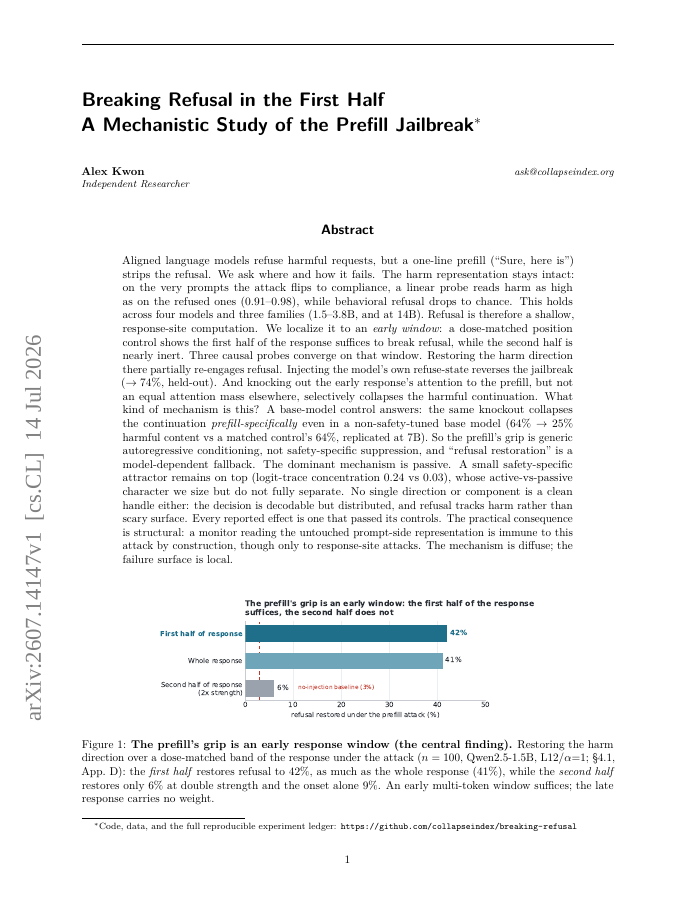
Aligned language models refuse harmful requests, but a one-line prefill ("Sure, here is") strips the refusal. We ask where and how it fails. The harm representation stays intact: on the prompts the attack flips to compliance, a linear probe reads harm as high as on the refused ones (0.91-0.98), while behavioral refusal drops to chance. This holds across four models and three families (1.5-3.8B, and at 14B). Refusal is therefore a shallow, response-site computation. We localize it to an early window: a dose-matched position control shows the first half of the response suffices to break refusal, while the second half is nearly inert. Three causal probes converge on that window. Restoring the harm direction there partially re-engages refusal. Injecting the model's own refuse-state reverses the jailbreak (74%, held-out). And knocking out the early response's attention to the prefill, but not an equal attention mass elsewhere, selectively collapses the harmful continuation. A base-model control identifies the mechanism: the same knockout collapses the continuation prefill-specifically even in a non-safety-tuned base model (64% to 25% harmful content vs a matched control's 64%, replicated at 7B). So the prefill's grip is generic autoregressive conditioning, not safety-specific suppression, and "refusal restoration" is a model-dependent fallback. The dominant mechanism is passive. A small safety-specific attractor remains on top (logit-trace concentration 0.24 vs 0.03), whose active-vs-passive character we size but do not fully separate. No single direction or component is a clean handle either: the decision is decodable but distributed, and refusal tracks harm rather than scary surface. The consequence is structural: a monitor reading the untouched prompt-side representation is immune by construction, but only to response-site attacks. The mechanism is diffuse; the failure surface is local.
Breaking Refusal in the First Half: A Mechanistic Study of the Prefill Jailbreak
Aligned language models refuse harmful requests, but a one-line prefill ("Sure, here is") strips the refusal. We ask where and how it fails. The harm representation stays intact: on the prompts the attack flips to compliance, a linear probe reads harm as high as on the…
- Preview
- Year
- 2026
- Hosting
- Full text hostedCC-BY-4.0
Cite
Notes
Only stored in your browser.
Attribution
- Abstract & full text
- arxiv.org/abs/2607.14147CC-BY-4.0
- TL;DR
- Semantic Scholar