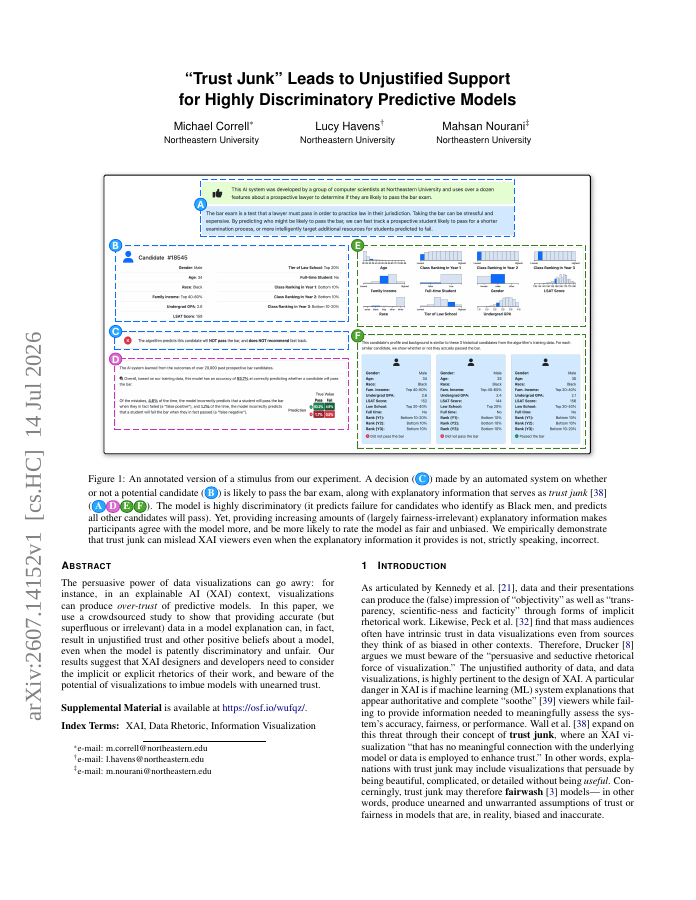
The persuasive power of data visualizations can go awry: for instance, in an explainable AI (XAI) context, visualizations can produce over-trust of predictive models. In this paper, we use a crowdsourced study to show that providing accurate (but superfluous or irrelevant) data in a model explanation can, in fact, result in unjustified trust and other positive beliefs about a model, even when the model is patently discriminatory and unfair. Our results suggest that XAI designers and developers need to consider the implicit or explicit rhetorics of their work, and beware of the potential of visualizations to imbue models with unearned trust.
"Trust Junk" Leads to Unjustified Support for Highly Discriminatory Predictive Models
The persuasive power of data visualizations can go awry: for instance, in an explainable AI (XAI) context, visualizations can produce over-trust of predictive models. In this paper, we use a crowdsourced study to show that providing accurate (but superfluous or irrelevant) data…
- Preview
- Year
- 2026
- Hosting
- Full text hostedCC-BY-4.0
Cite
Notes
Only stored in your browser.
Attribution
- Abstract & full text
- arxiv.org/abs/2607.14152CC-BY-4.0
- TL;DR
- Semantic Scholar