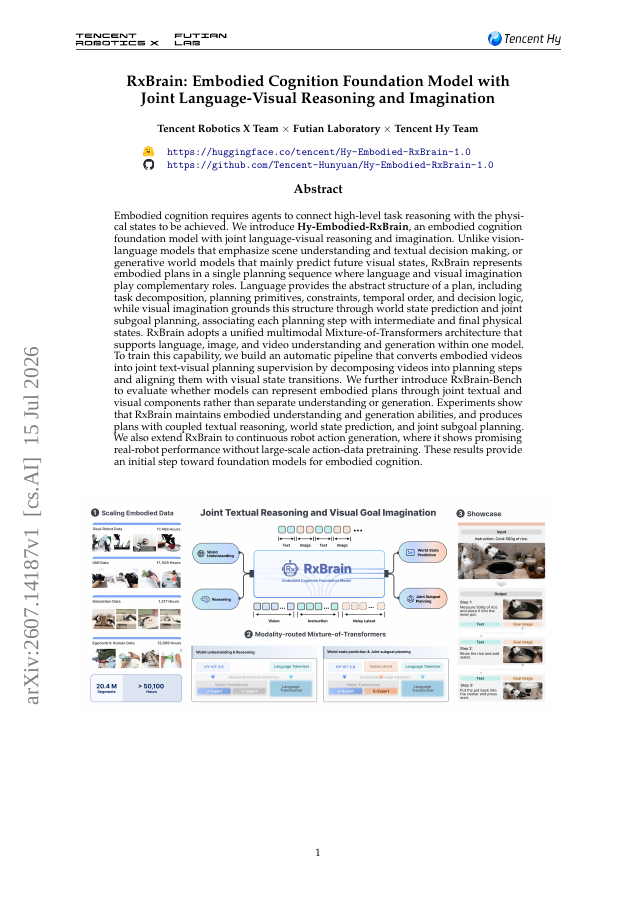
Embodied cognition requires agents to connect high-level task reasoning with the physical states to be achieved. We introduce Hy-Embodied-RxBrain, an embodied cognition foundation model with joint language-visual reasoning and imagination. Unlike vision-language models that emphasize scene understanding and textual decision making, or generative world models that mainly predict future visual states, RxBrain represents embodied plans in a single planning sequence where language and visual imagination play complementary roles. Language provides the abstract structure of a plan, including task decomposition, planning primitives, constraints, temporal order, and decision logic, while visual imagination grounds this structure through world state prediction and joint subgoal planning, associating each planning step with intermediate and final physical states. RxBrain adopts a unified multimodal Mixture-of-Transformers architecture that supports language, image, and video understanding and generation within one model. To train this capability, we build an automatic pipeline that converts embodied videos into joint text-visual planning supervision by decomposing videos into planning steps and aligning them with visual state transitions. We further introduce RxBrain-Bench to evaluate whether models can represent embodied plans through joint textual and visual components rather than separate understanding or generation. Experiments show that RxBrain maintains embodied understanding and generation abilities, and produces plans with coupled textual reasoning, world state prediction, and joint subgoal planning. We also extend RxBrain to continuous robot action generation, where it shows promising real-robot performance without large-scale action-data pretraining. These results provide an initial step toward foundation models for embodied cognition.
RxBrain: Embodied Cognition Foundation Model with Joint Language-Visual Reasoning and Imagination
Embodied cognition requires agents to connect high-level task reasoning with the physical states to be achieved. We introduce Hy-Embodied-RxBrain, an embodied cognition foundation model with joint language-visual reasoning and imagination.
- Preview
- Year
- 2026
- Hosting
- Abstract onlyARXIV-DEFAULT
Cite
Notes
Only stored in your browser.
Attribution
- Abstract & full text
- arxiv.org/abs/2607.14187ARXIV-DEFAULT
- TL;DR
- Semantic Scholar