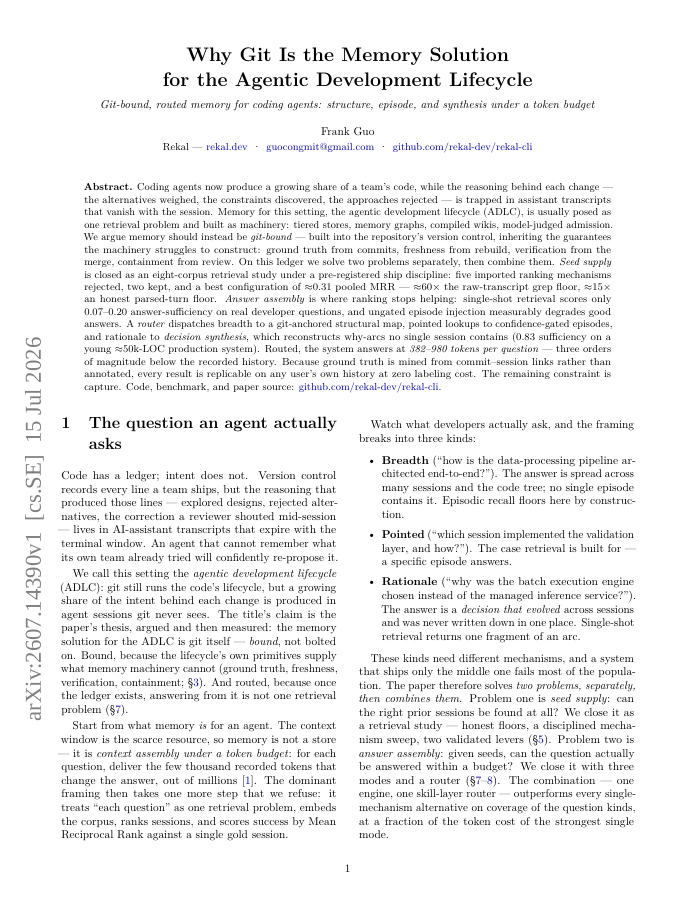
Coding agents now produce a growing share of a team's code, while the reasoning behind each change -- the alternatives weighed, the constraints discovered, the approaches rejected -- is trapped in assistant transcripts that vanish with the session. Memory for this setting, the agentic development lifecycle (ADLC), is usually posed as one retrieval problem and built as machinery: tiered stores, memory graphs, compiled wikis, model-judged admission. We argue memory should instead be git-bound -- built into the repository's version control, inheriting the guarantees the machinery struggles to construct: ground truth from commits, freshness from rebuild, verification from the merge, containment from review. On this ledger we solve two problems separately, then combine them. Seed supply is closed as an eight-corpus retrieval study under a pre-registered ship discipline: five imported ranking mechanisms rejected, two kept, and a best configuration of 0.31 pooled MRR -- 60x the raw-transcript grep floor, 15x an honest parsed-turn floor. Answer assembly is where ranking stops helping: single-shot retrieval scores only 0.07-0.20 answer-sufficiency on real developer questions, and ungated episode injection measurably degrades good answers. A router dispatches breadth to a git-anchored structural map, pointed lookups to confidence-gated episodes, and rationale to decision synthesis, which reconstructs why-arcs no single session contains (0.83 sufficiency on a young 50k-LOC production system). Routed, the system answers at 382-980 tokens per question -- three orders of magnitude below the recorded history. Because ground truth is mined from commit-session links rather than annotated, every result is replicable on any user's own history at zero labeling cost. The remaining constraint is capture. Code, benchmark, and paper source: github.com/rekal-dev/rekal-cli.
Why Git Is the Memory Solution for the Agentic Development Lifecycle
Coding agents now produce a growing share of a team's code, while the reasoning behind each change -- the alternatives weighed, the constraints discovered, the approaches rejected -- is trapped in assistant transcripts that vanish with the session.
- Preview
- Year
- 2026
- Hosting
- Full text hostedCC-BY-4.0
Cite
Notes
Only stored in your browser.
Attribution
- Abstract & full text
- arxiv.org/abs/2607.14390CC-BY-4.0
- TL;DR
- Semantic Scholar