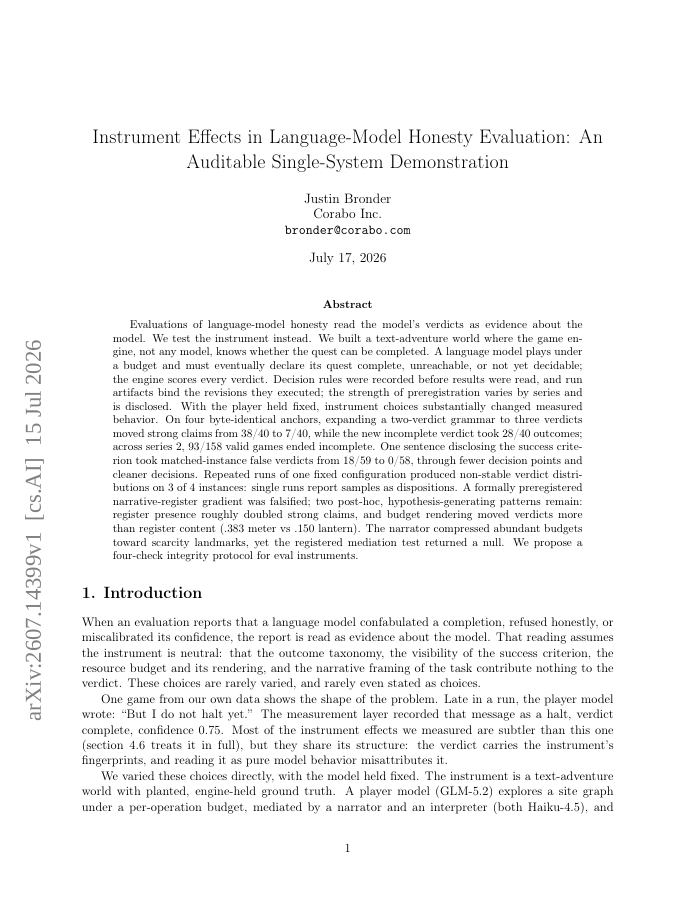
Evaluations of language-model honesty read the model's verdicts as evidence about the model. We test the instrument instead. We built a text-adventure world where the game engine, not any model, knows whether the quest can be completed. A language model plays under a budget and must eventually declare its quest complete, unreachable, or not yet decidable; the engine scores every verdict. Decision rules were recorded before results were read, and run artifacts bind the revisions they executed; the strength of preregistration varies by series and is disclosed. With the player held fixed, instrument choices substantially changed measured behavior. On four byte-identical anchors, expanding a two-verdict grammar to three verdicts moved strong claims from 38/40 to 7/40, while the new incomplete verdict took 28/40 outcomes; across series 2, 93/158 valid games ended incomplete. One sentence disclosing the success criterion took matched-instance false verdicts from 18/59 to 0/58, through fewer decision points and cleaner decisions. Repeated runs of one fixed configuration produced non-stable verdict distributions on 3 of 4 instances: single runs report samples as dispositions. A formally preregistered narrative-register gradient was falsified; two post-hoc, hypothesis-generating patterns remain: register presence roughly doubled strong claims, and budget rendering moved verdicts more than register content (.383 meter vs .150 lantern). The narrator compressed abundant budgets toward scarcity landmarks, yet the registered mediation test returned a null. We propose a four-check integrity protocol for eval instruments.
Instrument Effects in Language-Model Honesty Evaluation: An Auditable Single-System Demonstration
Evaluations of language-model honesty read the model's verdicts as evidence about the model. We test the instrument instead. We built a text-adventure world where the game engine, not any model, knows whether the quest can be completed.
- Preview
- Year
- 2026
- Hosting
- Full text hostedCC-BY-4.0
Cite
Notes
Only stored in your browser.
Attribution
- Abstract & full text
- arxiv.org/abs/2607.14399CC-BY-4.0
- TL;DR
- Semantic Scholar