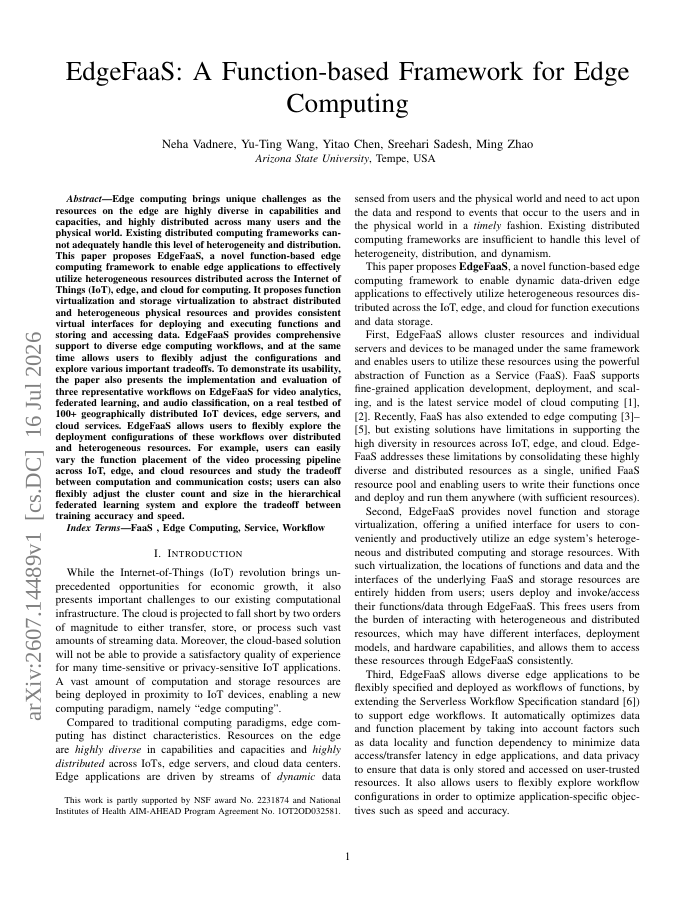
Edge computing brings unique challenges as the resources on the edge are highly diverse in capabilities and capacities, and highly distributed across many users and the physical world. Existing distributed computing frameworks cannot adequately handle this level of heterogeneity and distribution. This paper proposes EdgeFaaS, a novel function-based edge computing framework to enable edge applications to effectively utilize heterogeneous resources distributed across the Internet of Things (IoT), edge, and cloud for computing. It proposes function virtualization and storage virtualization to abstract distributed and heterogeneous physical resources and provides consistent virtual interfaces for deploying and executing functions and storing and accessing data. EdgeFaaS provides comprehensive support to diverse edge computing workflows, and at the same time allows users to flexibly adjust the configurations and explore various important tradeoffs. To demonstrate its usability, the paper also presents the implementation and evaluation of three representative workflows on EdgeFaaS for video analytics, federated learning, and audio classification, on a real testbed of 100+ geographically distributed IoT devices, edge servers, and cloud services. EdgeFaaS allows users to flexibly explore the deployment configurations of these workflows over distributed and heterogeneous resources. For example, users can easily vary the function placement of the video processing pipeline across IoT, edge, and cloud resources and study the tradeoff between computation and communication costs; users can also flexibly adjust the cluster count and size in the hierarchical federated learning system and explore the tradeoff between training accuracy and speed.
EdgeFaaS: A Function-based Framework for Edge Computing
Edge computing brings unique challenges as the resources on the edge are highly diverse in capabilities and capacities, and highly distributed across many users and the physical world.
- Preview
- Year
- 2026
- Hosting
- Abstract onlyARXIV-DEFAULT
Cite
Notes
Only stored in your browser.
Attribution
- Abstract & full text
- arxiv.org/abs/2607.14489ARXIV-DEFAULT
- TL;DR
- Semantic Scholar