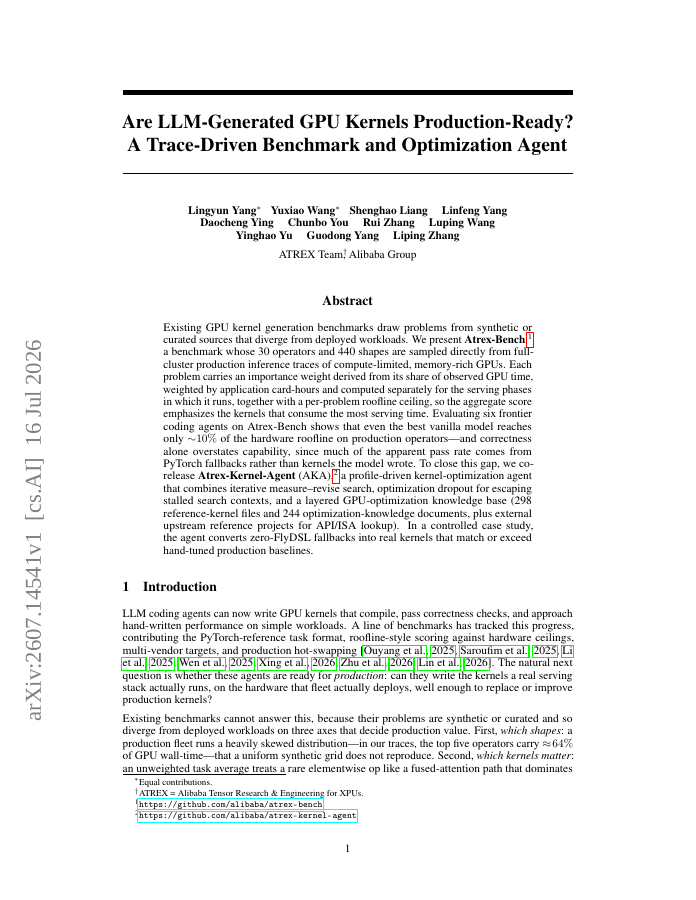
Existing GPU kernel generation benchmarks draw problems from synthetic or curated sources that diverge from deployed workloads. We present Atrex-Bench, a benchmark whose 30 operators and 440 shapes are sampled directly from full-cluster production inference traces of compute-limited, memory-rich GPUs. Each problem carries an importance weight derived from its share of observed GPU time, weighted by application card-hours and computed separately for the serving phases in which it runs, together with a per-problem roofline ceiling, so the aggregate score emphasizes the kernels that consume the most serving time. Evaluating six frontier coding agents on Atrex-Bench shows that even the best vanilla model reaches only {\sim}10% of the hardware roofline on production operators; and correctness alone overstates capability, since much of the apparent pass rate comes from PyTorch fallbacks rather than kernels the model wrote. To close this gap, we co-release Atrex-Kernel-Agent (AKA), a profile-driven kernel-optimization agent that combines iterative measure-revise search, optimization dropout for escaping stalled search contexts, and a layered GPU-optimization knowledge base (298 reference-kernel files and 244 optimization-knowledge documents, plus external upstream reference projects for API/ISA lookup). In a controlled case study, the agent converts zero-FlyDSL fallbacks into real kernels that match or exceed hand-tuned production baselines.
Are LLM-Generated GPU Kernels Production-Ready? A Trace-Driven Benchmark and Optimization Agent
Existing GPU kernel generation benchmarks draw problems from synthetic or curated sources that diverge from deployed workloads. We present Atrex-Bench, a benchmark whose 30 operators and 440 shapes are sampled directly from full-cluster production inference traces of…
- Preview
- Year
- 2026
- Hosting
- Full text hostedCC-BY-4.0
Cite
Notes
Only stored in your browser.
Attribution
- Abstract & full text
- arxiv.org/abs/2607.14541CC-BY-4.0
- TL;DR
- Semantic Scholar