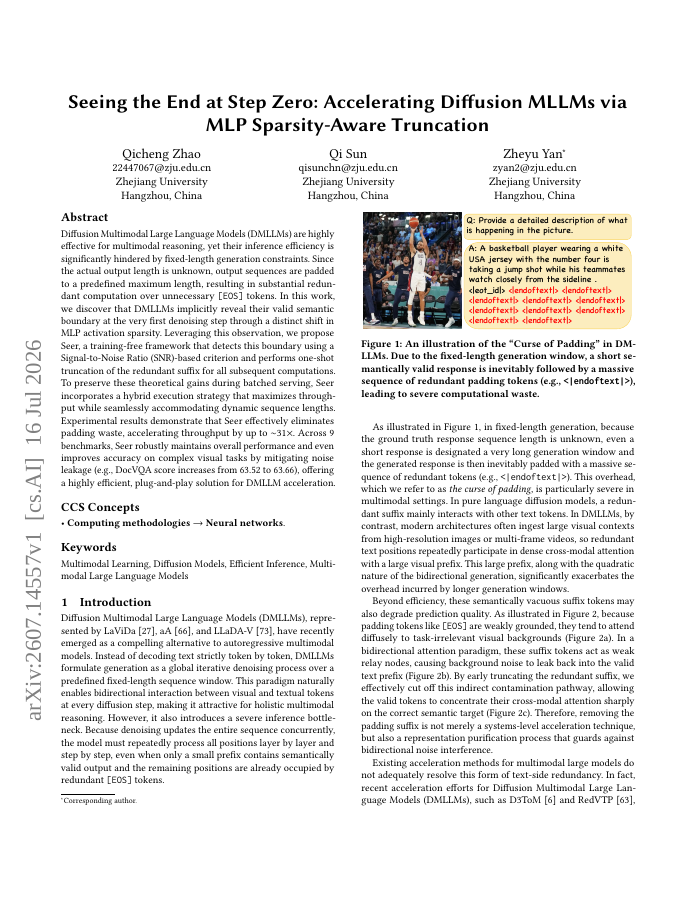
Diffusion Multimodal Large Language Models (DMLLMs) are highly effective for multimodal reasoning, yet their inference efficiency is significantly hindered by fixed-length generation constraints. Since the actual output length is unknown, output sequences are padded to a predefined maximum length, resulting in substantial redundant computation over unnecessary [EOS] tokens. In this work, we discover that DMLLMs implicitly reveal their valid semantic boundary at the very first denoising step through a distinct shift in MLP activation sparsity. Leveraging this observation, we propose Seer, a training-free framework that detects this boundary using a Signal-to-Noise Ratio (SNR)-based criterion and performs one-shot truncation of the redundant suffix for all subsequent computations. To preserve these theoretical gains during batched serving, Seer incorporates a hybrid execution strategy that maximizes throughput while seamlessly accommodating dynamic sequence lengths. Experimental results demonstrate that Seer effectively eliminates padding waste, accelerating throughput by up to \sim31\times. Across 9 benchmarks, Seer robustly maintains overall performance and even improves accuracy on complex visual tasks by mitigating noise leakage (e.g., DocVQA score increases from 63.52 to 63.66), offering a highly efficient, plug-and-play solution for DMLLM acceleration.
Seeing the End at Step Zero: Accelerating Diffusion MLLMs via MLP Sparsity-Aware Truncation
Diffusion Multimodal Large Language Models (DMLLMs) are highly effective for multimodal reasoning, yet their inference efficiency is significantly hindered by fixed-length generation constraints.
- Preview
- Year
- 2026
- Hosting
- Full text hostedCC-BY-4.0
Cite
Notes
Only stored in your browser.
Attribution
- Abstract & full text
- arxiv.org/abs/2607.14557CC-BY-4.0
- TL;DR
- Semantic Scholar