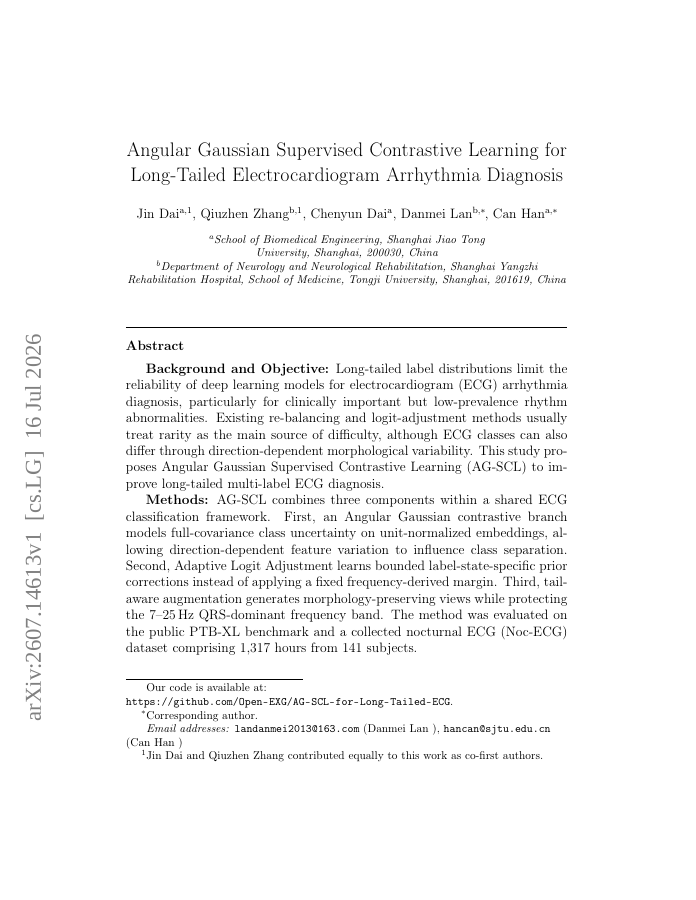
Long-tailed label distributions reduce the reliability of deep learning for electrocardiogram (ECG) arrhythmia diagnosis, particularly for clinically important but rare abnormalities. Existing rebalancing and logit adjustment methods mainly address class frequency while overlooking direction-dependent morphological variability across ECG classes. This study proposes Angular Gaussian Supervised Contrastive Learning (AG-SCL) for long-tailed multi-label ECG diagnosis. AG-SCL integrates three components into a unified framework: an Angular Gaussian contrastive branch that models full-covariance class uncertainty on unit-normalized embeddings, Adaptive Logit Adjustment that learns bounded label-state-specific prior corrections instead of fixed frequency-based margins, and tail-aware augmentation that generates morphology-preserving views while protecting the 7-25 Hz QRS-dominant band. The method was evaluated on the public PTB-XL benchmark and a nocturnal ECG dataset comprising 1317 hours of recordings from 141 subjects. AG-SCL achieved the best macro-level performance on both datasets. On PTB-XL, it obtained a balanced accuracy of 0.838, sensitivity of 0.709, specificity of 0.968, mean average precision of 0.495, and TPR at 5% FPR of 0.778. On Noc-ECG, the corresponding values were 0.918, 0.889, 0.947, 0.488, and 0.900. The largest gains occurred in rare or morphologically unstable rhythm classes, while ablation studies confirmed the contributions of full-covariance modelling, Adaptive Logit Adjustment, and tail-aware augmentation. AG-SCL improves long-tailed ECG diagnosis by combining prior calibration with anisotropic representation learning, enhancing sensitivity to rare arrhythmias while maintaining clinically relevant specificity. Our code is available at: https://github.com/Open-EXG/AG-SCL-for-Long-Tailed-ECG.
Angular Gaussian Supervised Contrastive Learning for Long-Tailed Electrocardiogram Arrhythmia Diagnosis
Long-tailed label distributions reduce the reliability of deep learning for electrocardiogram (ECG) arrhythmia diagnosis, particularly for clinically important but rare abnormalities.
- Preview
- Year
- 2026
- Hosting
- Abstract onlyARXIV-DEFAULT
Cite
Notes
Only stored in your browser.
Attribution
- Abstract & full text
- arxiv.org/abs/2607.14613ARXIV-DEFAULT
- TL;DR
- Semantic Scholar