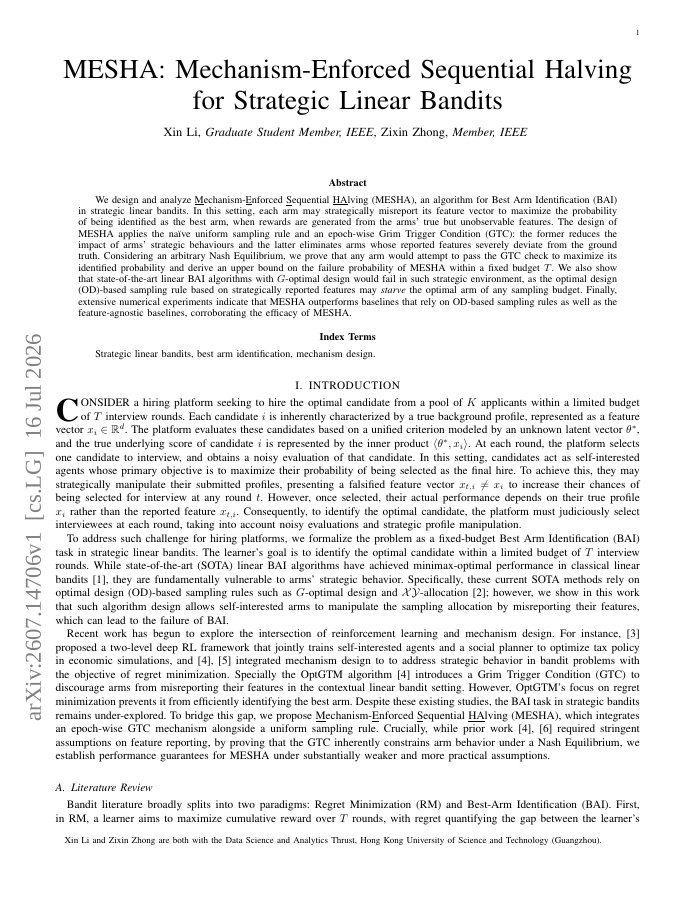
We design and analyze \underline{M}echanism-\underline{E}nforced \underline{S}equential \underline{HA}lving (MESHA), an algorithm for Best Arm Identification (BAI) in strategic linear bandits. In this setting, each arm may strategically misreport its feature vector to maximize the probability of being identified as the best arm, when rewards are generated from the arms' true but unobservable features. The design of MESHA applies the naïve uniform sampling rule and an epoch-wise Grim Trigger Condition (GTC): the former reduces the impact of arms' strategic behaviours and the latter eliminates arms whose reported features severely deviate from the ground truth. Considering an arbitrary Nash Equilibrium, we prove that any arm would attempt to pass the GTC check to maximize its identified probability and derive an upper bound on the failure probability of MESHA within a fixed budget T. We also show that state-of-the-art linear BAI algorithms with G-optimal design would fail in such strategic environment, as the optimal design (OD)-based sampling rule based on strategically reported features may {\it starve} the optimal arm of any sampling budget. Finally, extensive numerical experiments indicate that MESHA outperforms baselines that rely on OD-based sampling rules as well as the feature-agnostic baselines, corroborating the efficacy of MESHA.
MESHA: Mechanism-Enforced Sequential Halving for Strategic Linear Bandits
We design and analyze \underline{M}echanism-\underline{E}nforced \underline{S}equential \underline{HA}lving (MESHA), an algorithm for Best Arm Identification (BAI) in strategic linear bandits.
- Preview
- Year
- 2026
- Hosting
- Full text hostedCC-BY-4.0
Cite
Notes
Only stored in your browser.
Attribution
- Abstract & full text
- arxiv.org/abs/2607.14706CC-BY-4.0
- TL;DR
- Semantic Scholar