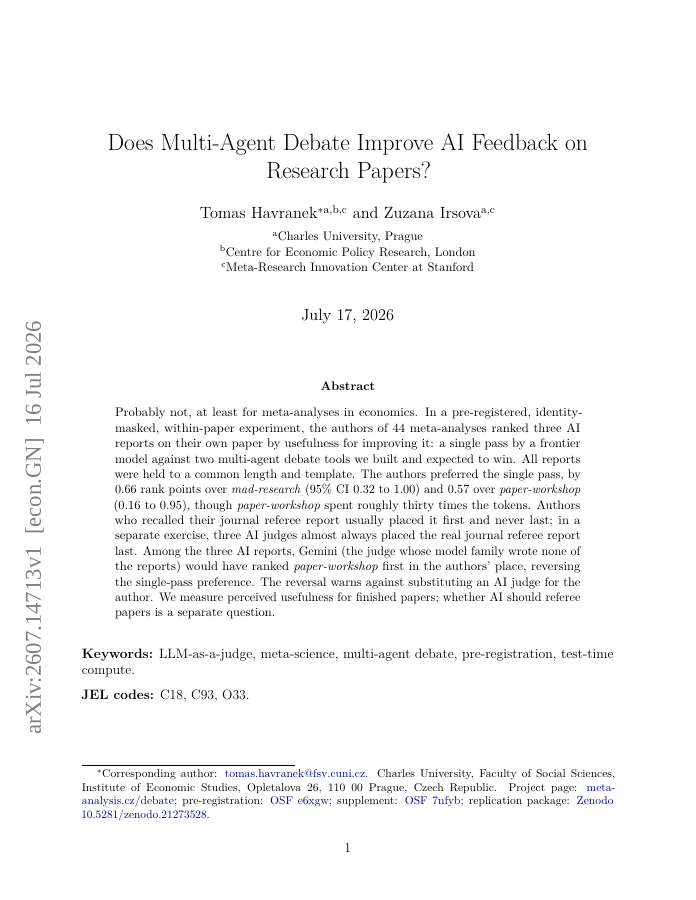
Probably not, at least for meta-analyses in economics. In a pre-registered, identity-masked, within-paper experiment, the authors of 44 meta-analyses ranked three AI reports on their own paper by usefulness for improving it: a single pass by a frontier model against two multi-agent debate tools we built and expected to win. All reports were held to a common length and template. The authors preferred the single pass, by 0.66 rank points over mad-research (95% CI 0.32 to 1.00) and 0.57 over paper-workshop (0.16 to 0.95), though paper-workshop spent roughly thirty times the tokens. Authors who recalled their journal referee report usually placed it first and never last; in a separate exercise, three AI judges almost always placed the real journal referee report last. Among the three AI reports, Gemini (the judge whose model family wrote none of the reports) would have ranked paper-workshop first in the authors' place, reversing the single-pass preference. The reversal warns against substituting an AI judge for the author. We measure perceived usefulness for finished papers; whether AI should referee papers is a separate question.
Does Multi-Agent Debate Improve AI Feedback on Research Papers?
Probably not, at least for meta-analyses in economics. In a pre-registered, identity-masked, within-paper experiment, the authors of 44 meta-analyses ranked three AI reports on their own paper by usefulness for improving it: a single pass by a frontier model against two…
- Preview
- Year
- 2026
- Hosting
- Excerpt onlyCC-BY-NC-4.0
Cite
Notes
Only stored in your browser.
Attribution
- Abstract & full text
- arxiv.org/abs/2607.14713CC-BY-NC-4.0
- TL;DR
- Semantic Scholar