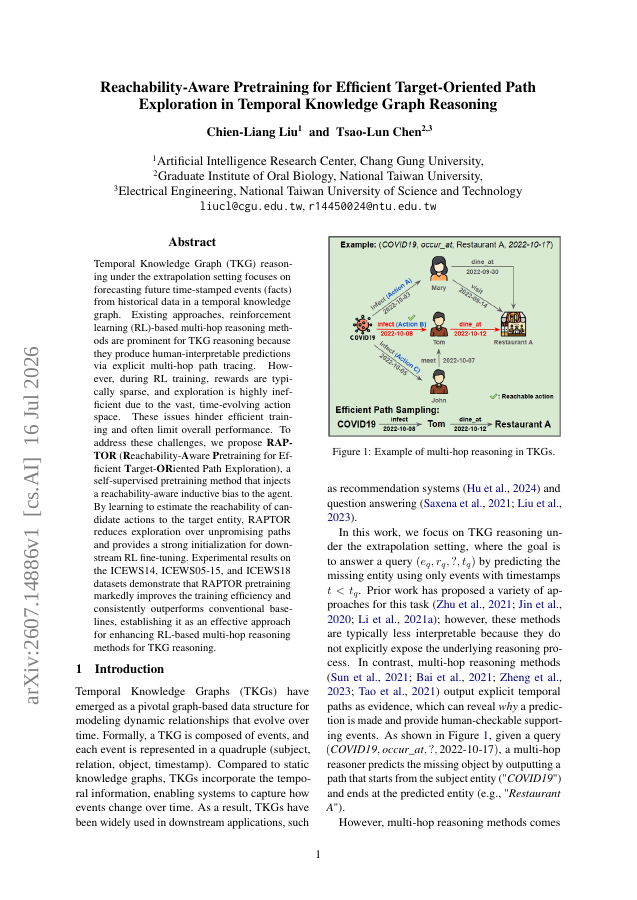
Temporal Knowledge Graph (TKG) reasoning under the extrapolation setting focuses on forecasting future time-stamped events (facts) from historical data in a temporal knowledge graph. Existing approaches, reinforcement learning (RL)-based multi-hop reasoning methods are prominent for TKG reasoning because they produce human-interpretable predictions via explicit multi-hop path tracing. However, during RL training, rewards are typically sparse, and exploration is highly inefficient due to the vast, time-evolving action space. These issues hinder efficient training and often limit overall performance. To address these challenges, we propose RAPTOR (Reachability-Aware Pretraining for Efficient Target-Oriented Path Exploration), a self-supervised pretraining method that injects a reachability-aware inductive bias to the agent. By learning to estimate the reachability of candidate actions to the target entity, RAPTOR reduces exploration over unpromising paths and provides a strong initialization for downstream RL fine-tuning. Experimental results on the ICEWS14, ICEWS05-15, and ICEWS18 datasets demonstrate that RAPTOR pretraining markedly improves the training efficiency and consistently outperforms conventional baselines, establishing it as an effective approach for enhancing RL-based multi-hop reasoning methods for TKG reasoning.
Reachability-Aware Pretraining for Efficient Target-Oriented Path Exploration in Temporal Knowledge Graph Reasoning
Temporal Knowledge Graph (TKG) reasoning under the extrapolation setting focuses on forecasting future time-stamped events (facts) from historical data in a temporal knowledge graph.
- Preview
- Year
- 2026
- Hosting
- Abstract onlyARXIV-DEFAULT
Cite
Notes
Only stored in your browser.
Attribution
- Abstract & full text
- arxiv.org/abs/2607.14886ARXIV-DEFAULT
- TL;DR
- Semantic Scholar