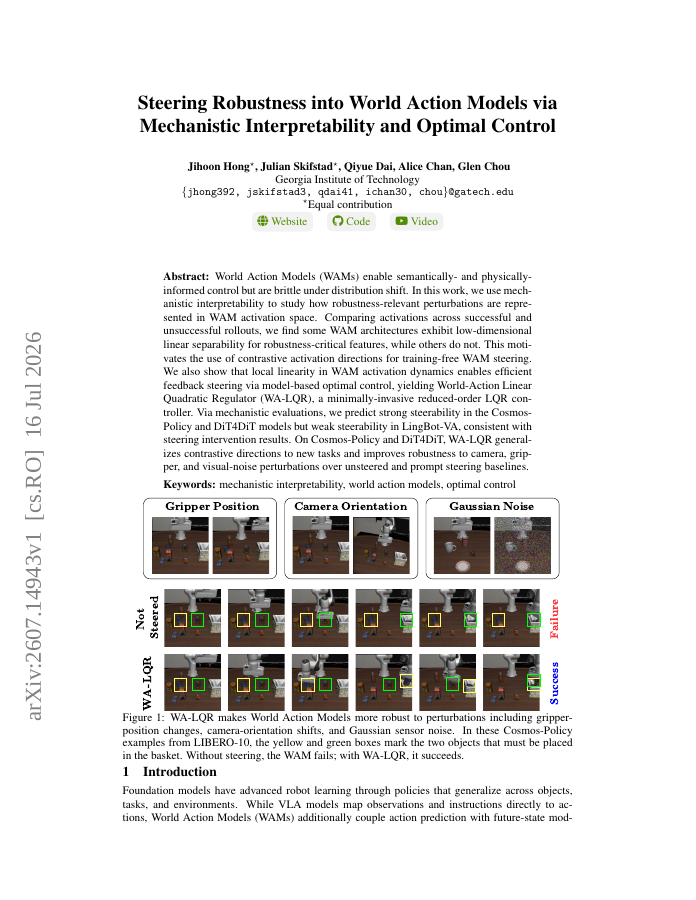
World Action Models (WAMs) enable semantically- and physically-informed control but are brittle under distribution shift. In this work, we use mechanistic interpretability to study how robustness-relevant perturbations are represented in WAM activation space. Comparing activations across successful and unsuccessful rollouts, we find some WAM architectures exhibit low-dimensional linear separability for robustness-critical features, while others do not. This motivates the use of contrastive activation directions for training-free WAM steering. We also show that local linearity in WAM activation dynamics enables efficient feedback steering via model-based optimal control, yielding World-Action Linear Quadratic Regulator (WA-LQR), a minimally-invasive reduced-order LQR controller. Via mechanistic evaluations, we predict strong steerability in the Cosmos-Policy and DiT4DiT models but weak steerability in LingBot-VA, consistent with steering intervention results. On Cosmos-Policy and DiT4DiT, WA-LQR generalizes contrastive directions to new tasks and improves robustness to camera, gripper, and visual-noise perturbations over unsteered and prompt steering baselines.
Steering Robustness into World Action Models via Mechanistic Interpretability and Optimal Control
World Action Models (WAMs) enable semantically- and physically-informed control but are brittle under distribution shift. In this work, we use mechanistic interpretability to study how robustness-relevant perturbations are represented in WAM activation space.
- Preview
- Year
- 2026
- Hosting
- Full text hostedCC-BY-4.0
Cite
Notes
Only stored in your browser.
Attribution
- Abstract & full text
- arxiv.org/abs/2607.14943CC-BY-4.0
- TL;DR
- Semantic Scholar