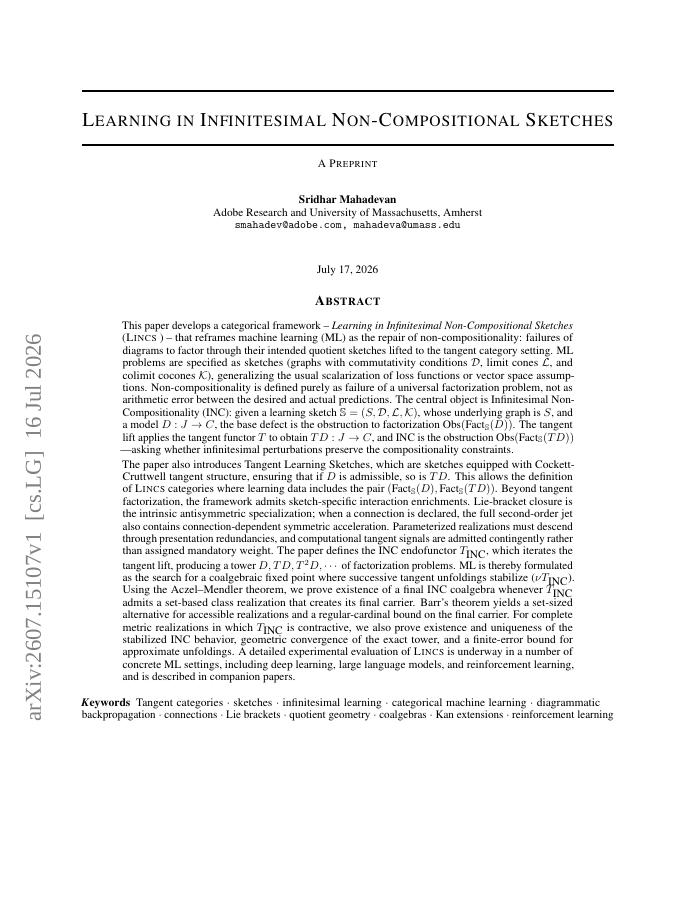
This paper develops a categorical framework -- Learning in Infinitesimal Non-Compositional Sketches (LINCS) -- as the repair of non-compositionality: failures of diagrams to factor through quotient sketches lifted to the tangent category setting. Machine learning problems are specified as sketches: graphs with commutativity conditions \mathcal D, limit cones \mathcal L, and colimit cocones \mathcal K, generalizing the usual scalarization of loss functions or vector space assumptions. Non-compositionality is defined purely as failure of a universal factorization problem, not as arithmetic error between the desired and actual predictions. Given a learning sketch \mathbb S=(S,\mathcal D,\mathcal L,\mathcal K), whose underlying graph is S, and a model D:J \rightarrow C, the base defect is the obstruction to factorization \mbox{Obs}(\mbox{Fact}{\mathbb S}(D)). The tangent lift applies the tangent functor T to obtain TD:J \rightarrow C, and LINCS is defined as the obstruction \mbox{Obs}(\mbox{Fact}{\mathbb S}(TD)) -- asking whether infinitesimal perturbations preserve the compositionality constraints.The paper also introduces Tangent Learning Sketches, which are sketches equipped with Cockett-Cruttwell tangent structure. The paper defines the INC endofunctor, which iterates the tangent lift, producing a tower D,TD,T^2D, \cdots of factorization problems. ML is thereby formulated as the search for a coalgebraic fixed point where successive tangent unfoldings stabilize (νT_{\mbox{INC}}). Using the Aczel--Mendler theorem, we prove existence of a final INC coalgebra whenever T_{\mbox{INC}} admits a set-based class realization that creates its final carrier. A detailed experimental evaluation of LINCS is underway in a number of concrete ML settings, including deep learning, large language models, and reinforcement learning, and is described in companion papers.
Learning in Infinitesimal Non-Compositional Sketches
This paper develops a categorical framework -- Learning in Infinitesimal Non-Compositional Sketches (LINCS) -- as the repair of non-compositionality: failures of diagrams to factor through quotient sketches lifted to the tangent category setting.
- Preview
- Year
- 2026
- Hosting
- Full text hostedCC-BY-4.0
Cite
Notes
Only stored in your browser.
Attribution
- Abstract & full text
- arxiv.org/abs/2607.15107CC-BY-4.0
- TL;DR
- Semantic Scholar