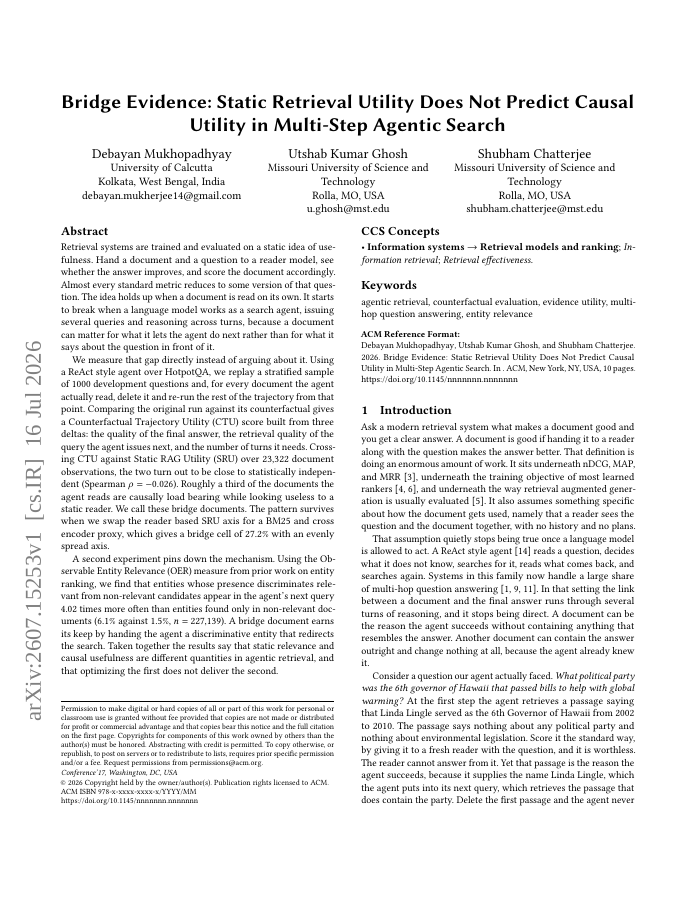
Retrieval systems are trained and evaluated on a static idea of usefulness: hand a document and a question to a reader model, see whether the answer improves, and score the document accordingly. The idea holds up when a document is read on its own. It breaks when a language model works as a search agent, issuing several queries and reasoning across turns, because a document can matter for what it lets the agent do next rather than for what it says about the current question. We measure that gap rather than argue it. Using a ReAct style agent over HotpotQA, we replay 1000 development questions and, for every document the agent read, delete it and re-run the rest of the trajectory from that point. Comparing the original run against its counterfactual gives a Counterfactual Trajectory Utility (CTU) score from three deltas: final answer quality, next query retrieval quality, and turn count. Crossing CTU against Static RAG Utility (SRU) over 23,322 document observations, the two are close to statistically independent (Spearman rho = -0.026). Roughly a third of the documents the agent reads are causally load bearing while looking useless to a static reader; we call these bridge documents. The pattern survives when the reader based axis is swapped for a BM25 and cross encoder proxy, giving a bridge cell of 27.2% on an evenly spread axis. A second experiment pins down the mechanism. Using the Observable Entity Relevance (OER) measure from prior work, entities that discriminate relevant from non-relevant candidates appear in the agent's next query 4.02 times more often than entities found only in non-relevant documents (6.1% vs 1.5%, n = 227,139). A bridge document earns its keep by handing the agent a discriminative entity that redirects the search. Static relevance and causal usefulness are different quantities in agentic retrieval, and optimizing the first does not deliver the second.
Bridge Evidence: Static Retrieval Utility Does Not Predict Causal Utility in Multi-Step Agentic Search
Retrieval systems are trained and evaluated on a static idea of usefulness: hand a document and a question to a reader model, see whether the answer improves, and score the document accordingly. The idea holds up when a document is read on its own.
- Preview
- Year
- 2026
- Hosting
- Full text hostedCC-BY-4.0
Cite
Notes
Only stored in your browser.
Attribution
- Abstract & full text
- arxiv.org/abs/2607.15253CC-BY-4.0
- TL;DR
- Semantic Scholar