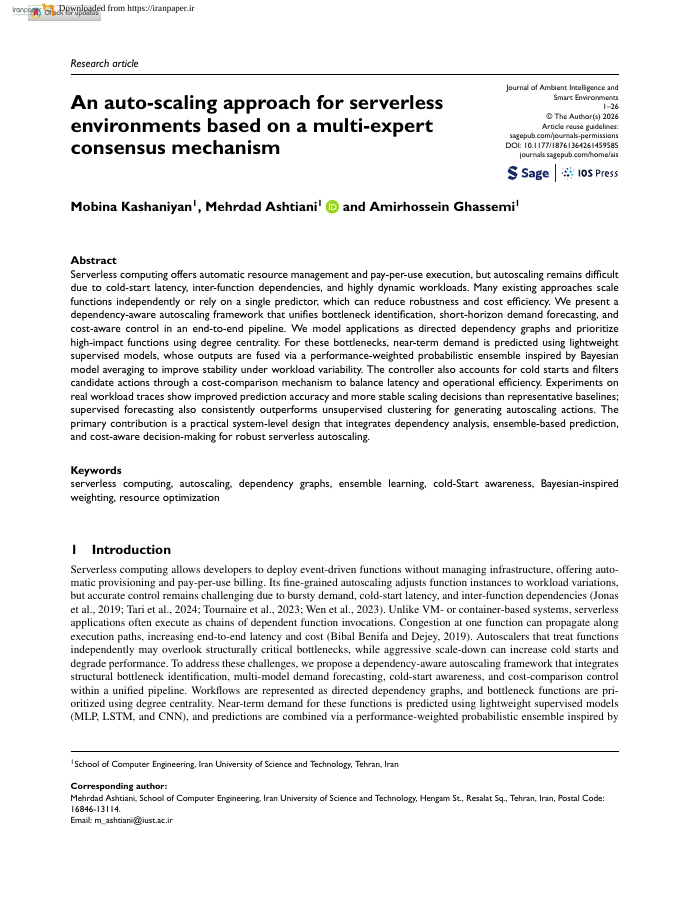
Serverless computing provides automatic resource management and pay-per-use execution, but effective autoscaling remains challenging because of dynamic workloads, cold-start latency, and dependencies among functions. We present a dependency-aware autoscaling framework that integrates graph-based bottleneck identification, short-term workload forecasting, multi-model consensus, and cost-aware scaling control. Serverless applications are represented as directed dependency graphs, and structurally important functions are identified using weighted degree centrality. Resource demand is predicted using lightweight MLP, LSTM, and CNN models. Their outputs are combined through a performance-weighted probabilistic ensemble inspired by Bayesian model averaging. The controller further incorporates cold-start awareness and cost comparison to select among scale-up, scale-down, and hold actions. Experiments using real workload traces show that supervised forecasting substantially outperforms unsupervised clustering for autoscaling decision generation. The proposed ensemble achieves 99.88 percent prediction accuracy and reduces prediction error compared with representative hybrid forecasting methods. Evaluations across multiple cloud pricing models also demonstrate consistent infrastructure cost reductions while maintaining performance targets. The results show that combining dependency analysis, multi-expert forecasting, and cost-aware control provides a robust and practical solution for serverless autoscaling.
An Auto-Scaling Approach for Serverless Environments Based on a Multi-Expert Consensus Mechanism
Serverless computing provides automatic resource management and pay-per-use execution, but effective autoscaling remains challenging because of dynamic workloads, cold-start latency, and dependencies among functions.
- Preview
- Year
- 2026
- Hosting
- Full text hostedCC-BY-4.0
Cite
Notes
Only stored in your browser.
Attribution
- Abstract & full text
- arxiv.org/abs/2607.15511CC-BY-4.0
- TL;DR
- Semantic Scholar