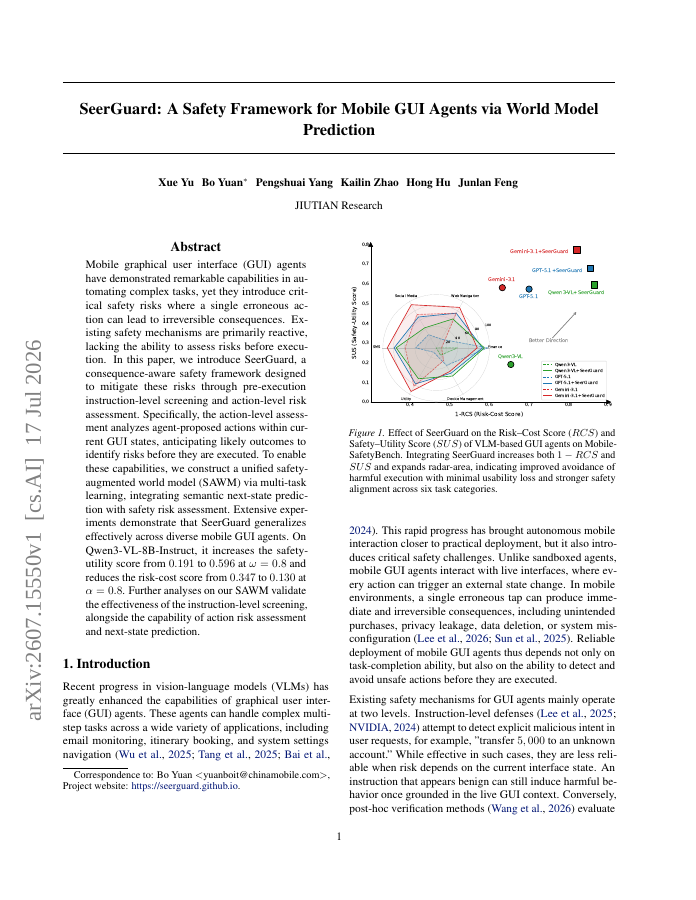
Mobile graphical user interface (GUI) agents have demonstrated remarkable capabilities in automating complex tasks, yet they introduce critical safety risks where a single erroneous action can lead to irreversible consequences. Existing safety mechanisms are primarily reactive, lacking the ability to assess risks before execution. In this paper, we introduce SeerGuard, a consequence-aware safety framework designed to mitigate these risks through pre-execution instruction-level screening and action-level risk assessment. Specifically, the action-level assessment analyzes agent-proposed actions within current GUI states, anticipating likely outcomes to identify risks before they are executed. To enable these capabilities, we construct a unified safety-augmented world model (SAWM) via multi-task learning, integrating semantic next-state prediction with safety risk assessment. Extensive experiments demonstrate that SeerGuard generalizes effectively across diverse mobile GUI agents. On Qwen3-VL-8B-Instruct, it increases the safety-utility score from 0.191 to 0.596 at ω=0.8 and reduces the risk-cost score from 0.347 to 0.130 at α=0.8. Further analyses on our SAWM validate the effectiveness of the instruction-level screening, alongside the capability of action risk assessment and next-state prediction.
SeerGuard: A Safety Framework for Mobile GUI Agents via World Model Prediction
Mobile graphical user interface (GUI) agents have demonstrated remarkable capabilities in automating complex tasks, yet they introduce critical safety risks where a single erroneous action can lead to irreversible consequences.
- Preview
- Year
- 2026
- Hosting
- Abstract onlyARXIV-DEFAULT
Cite
Notes
Only stored in your browser.
Attribution
- Abstract & full text
- arxiv.org/abs/2607.15550ARXIV-DEFAULT
- TL;DR
- Semantic Scholar